Why buying a €100m striker ruins great teams
Every time a team starts scoring loads of goals without a superstar striker, everyone says the same thing: imagine how good they would be if they just spent €100m on a 20-goal striker. In reality, that single signing is one of the fastest ways to ruin a great team.
Look at Brighton. Ten games into the 2026/27 Premier League season, they have scored 26 goals, more than anyone in England. They beat Arsenal 3-0, still Arsenal's only league defeat. And their top scorer is Pascal Groß, a 35-year-old midfielder with four goals.
This piece goes through why a big striker would break that attack, how Brighton score without one, and the hidden defensive problem they need to fix before their season falls apart. The tactics boards and data cards are the ones from my video, and every animation plays on a loop.
Why one main striker makes defending easy
To understand why a big striker can make a team worse, look at the game the way a defender does.
When you put a traditional main striker on the pitch, you make life easy for the other team's centre-backs. Their job is simple: stick to the striker, block his space, and push the ball out wide, away from goal.
It gets worse. Your own midfielders start forcing passes into him, even when a better pass is on.
Now take the main striker away and let everyone attack the box. There is no single target to mark, and five players arrive in the box from different places.
Eleven different scorers
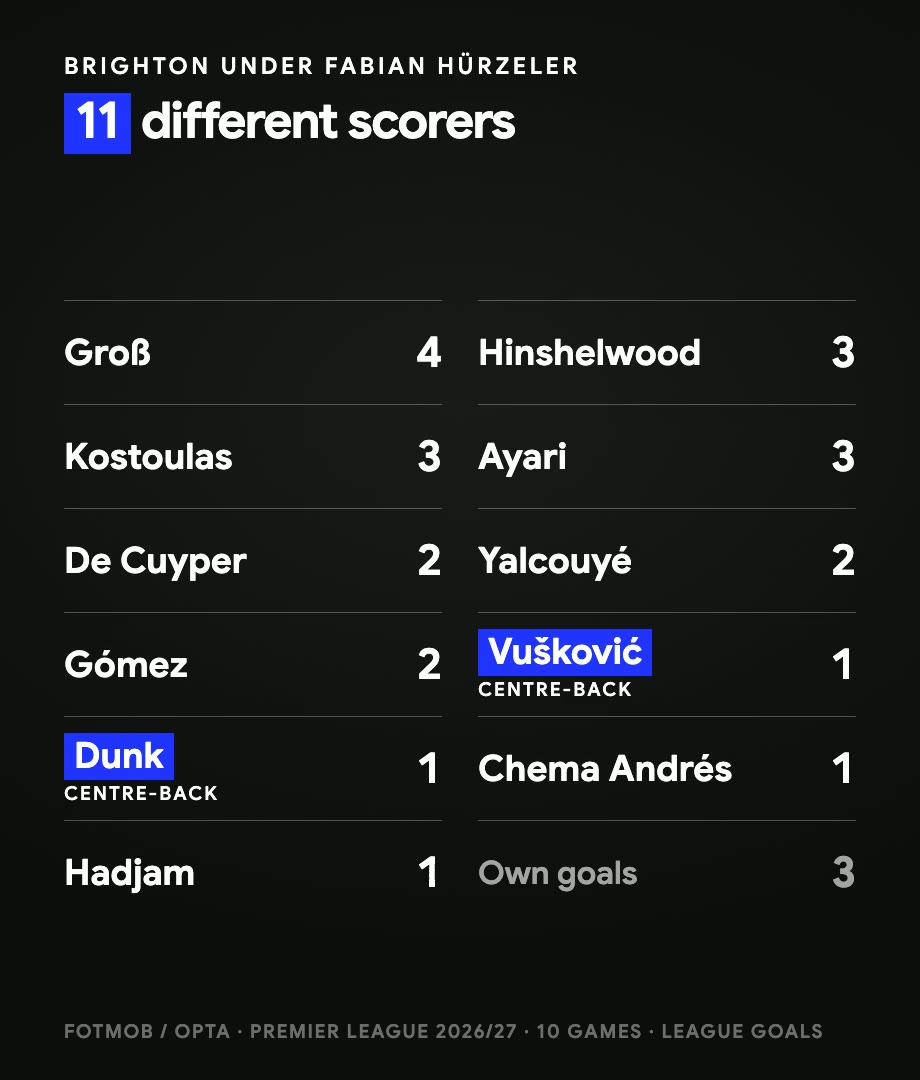
That is what Brighton look like under Fabian Hürzeler. Eleven different players have scored their league goals, including two centre-backs, Lewis Dunk and Luka Vušković.
With no main striker to mark, the other team's centre-backs have no idea who to follow. Do they step out to press the ball, or stay back to cover the midfielders running into the box?
That split-second of doubt is where the easy tap-ins and cut-backs come from. A cut-back is a pass pulled back from near the goal line to a player arriving in the middle.
Take away the two penalties and the three own goals, and Brighton have 21 goals. Midfielders and wingers scored 15 of them, 11 from inside the box. Charalampos Kostoulas, their one real striker, has three. You do not need one player taking all the shots when five players are attacking the empty spaces.
The player who makes it work
If there is no star striker finishing the chances, who is the most important player in this system? The one who sets the tempo.
Brighton sold Pascal Groß to Borussia Dortmund in 2024 for a reported €7m or so. Most clubs think a player in his mid-30s is finished. Brighton bought him back in January 2026 for a reported fee of under €2m. In my opinion, it is one of the smartest signings in Europe.
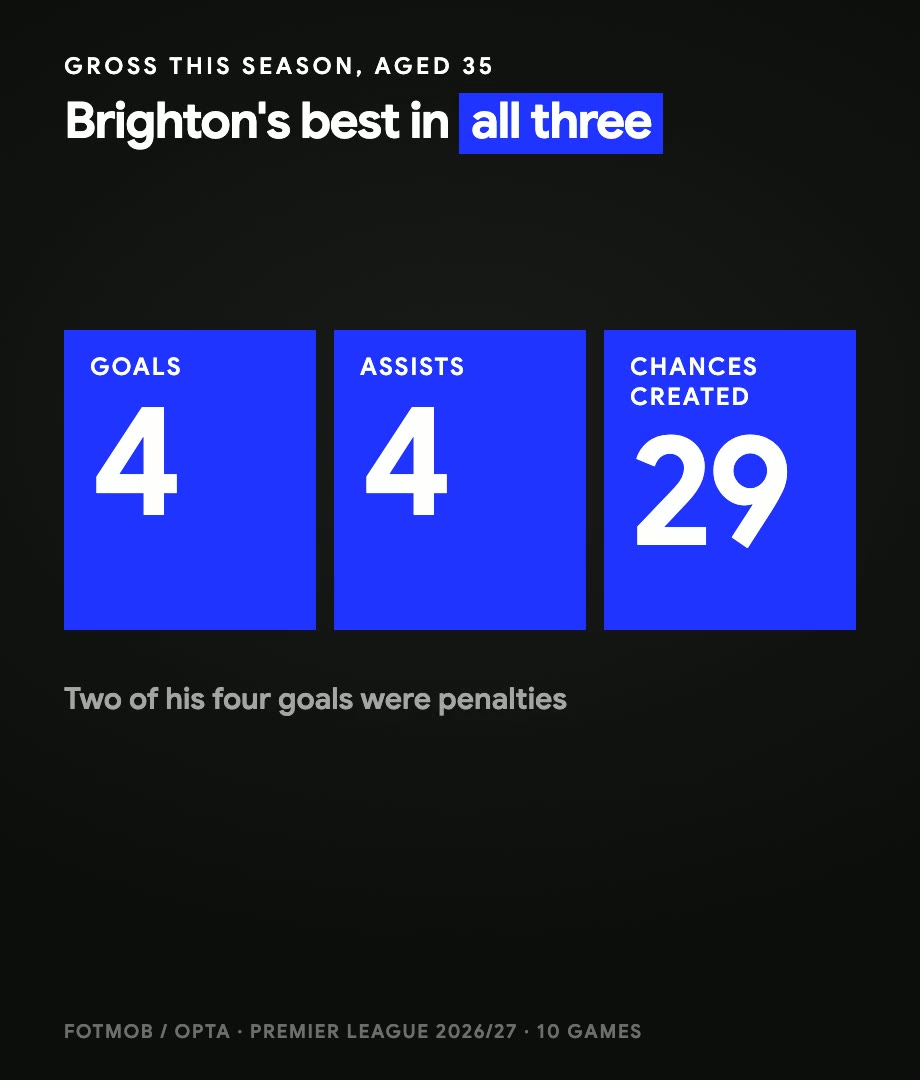
At 35, he leads Brighton in goals, assists and chances created.
Why does a 35-year-old midfielder outperform fast, expensive forwards in this set-up? Because this style of football is about timing and passing angles, not sprinting.
He finds the empty pocket of space between the other team's midfield and defence. Every time he gets the ball there, his teammates get an extra half-second to make runs behind the back line.
Now drop a €100m striker into that team. He stands in exactly that space. The defenders who were confused now have a target, the passing angles close, and an unpredictable attack becomes a predictable one.
Is the attack lucky too?
It is a fair question, and the honest answer is: a little. Brighton's own shots have produced 23 goals from chances worth 19.8 expected goals. Expected goals (xG) is how many goals a set of chances is worth on average, based on thousands of similar shots. So the attack is about three goals ahead of its chances, and the other three goals were own goals.
Some of that will even out. But the gap at the other end of the pitch is more than twice as big, and that is the one that should worry Brighton.
The hidden defensive problem
If you only look at the goals and the clean sheets, you would think Brighton are going to cruise into the Champions League. Seven clean sheets in ten games looks like an amazing defence.
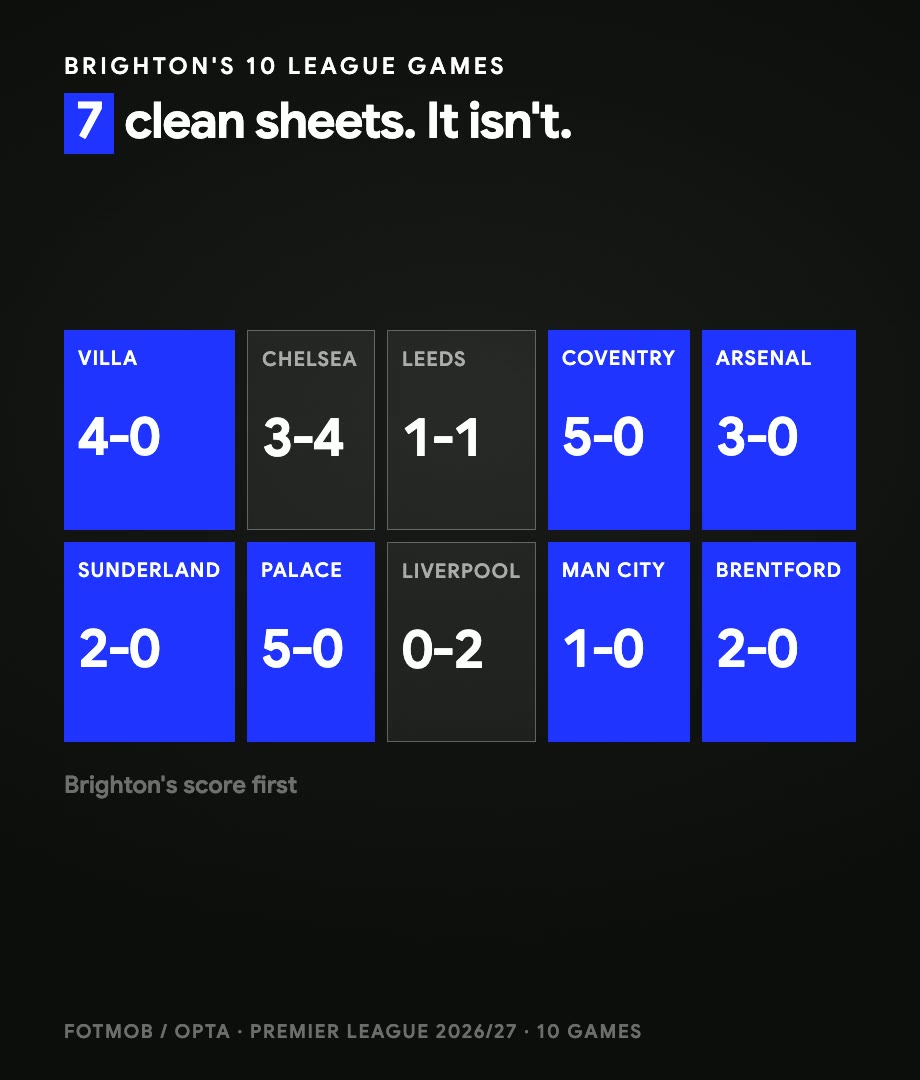
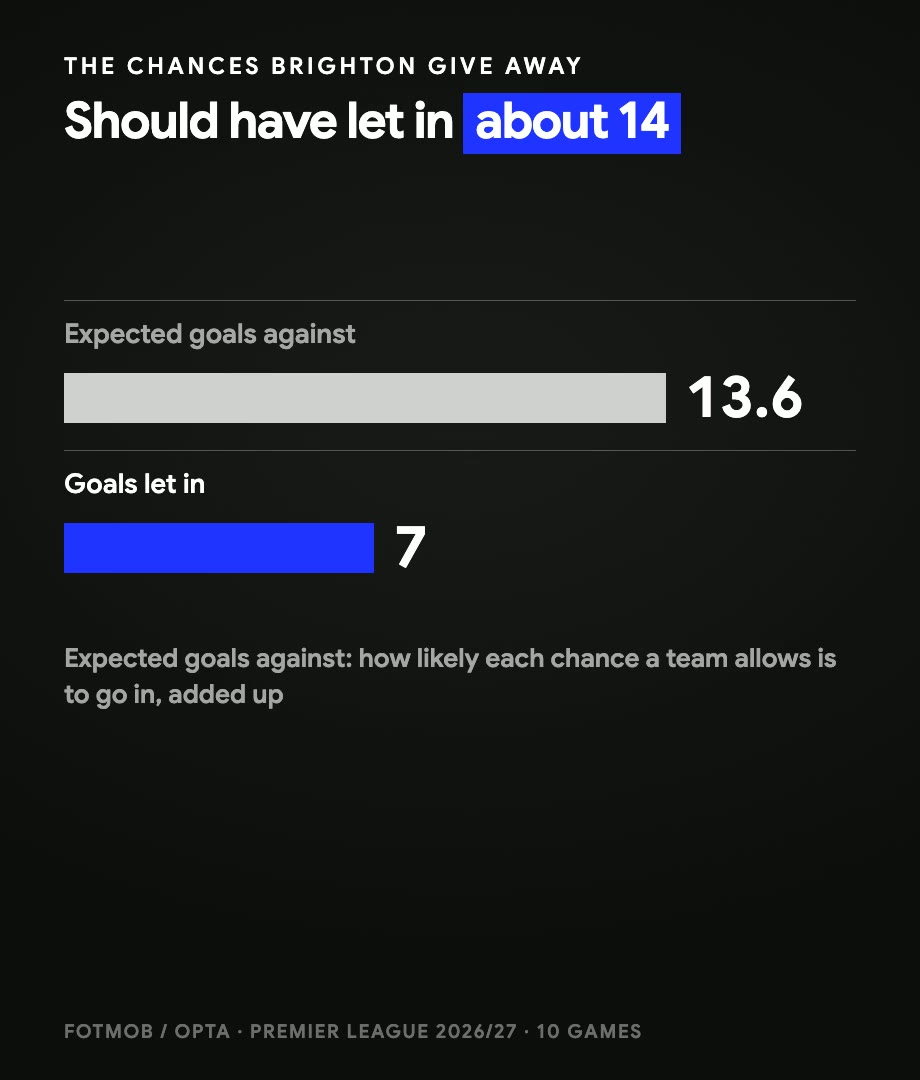
It isn't. Based on the quality of the chances Brighton give away, they should have conceded about 14 goals. They have let in 7.
On chances given away, they are only 8th in the league. Arsenal's chances against add up to 7.6, and that is a defence you can actually trust.
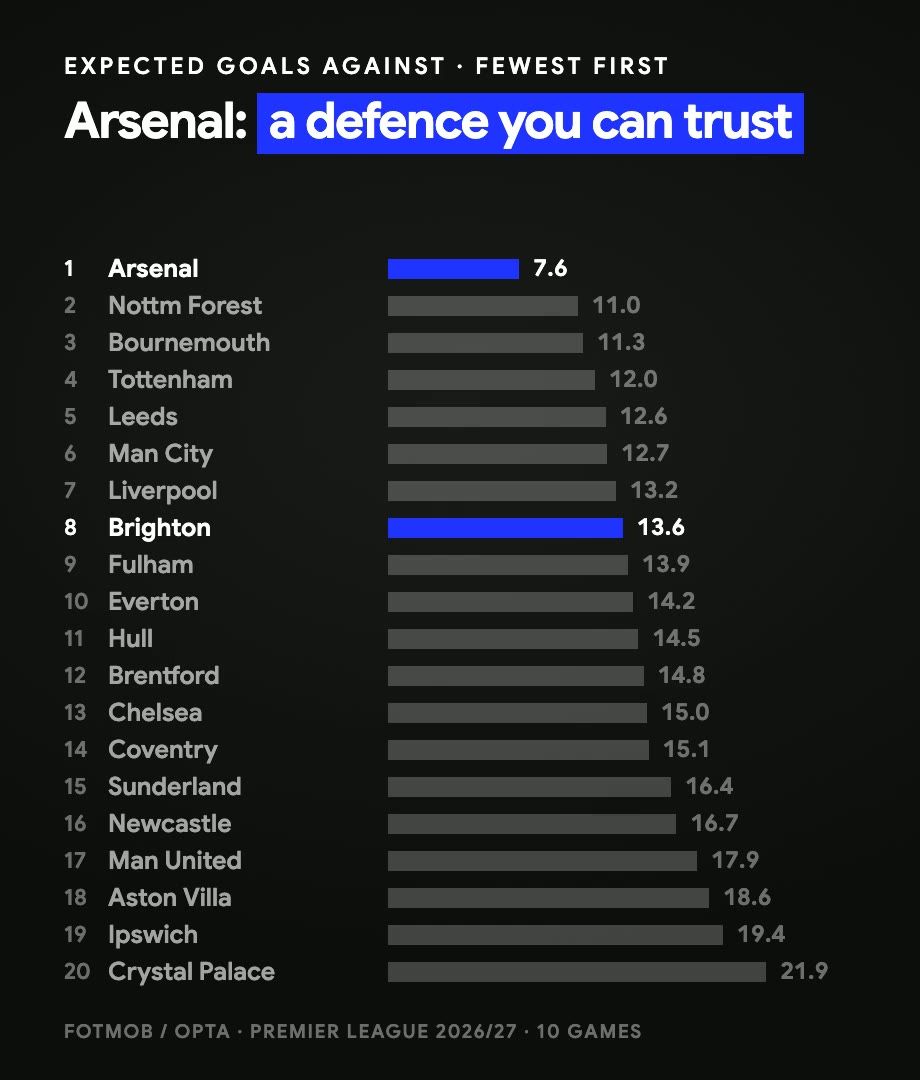
FotMob's team stats put Brighton's expected goals against at 13.6. Adding up their shot maps shot by shot, which I do below, gives 13.9. Either way, it is about 14.
Where the chances come from
Why are Brighton giving away so many big chances? Part of the answer is the same freedom that makes them dangerous going forward. When both fullbacks push high and the midfielders run into the box, very little is left behind the ball.
One bad pass in midfield, and Brighton's two centre-backs are defending 40 yards of open grass on the counter-attack.
That is the risk built into how they attack. But when I went through every shot Brighton have faced this season, the counter-attack is not the biggest leak so far. Corners are.
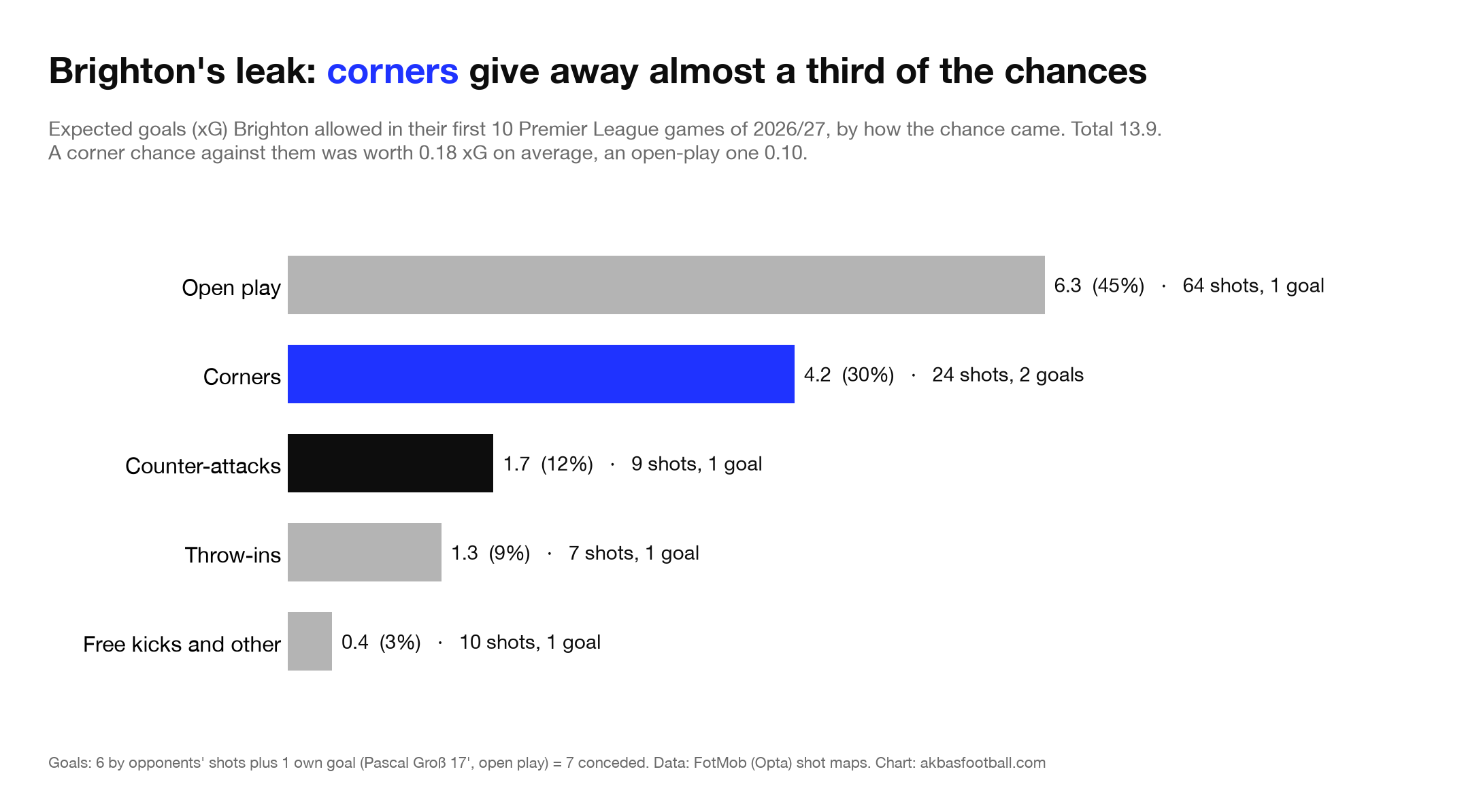
Corners have given away 4.2 of Brighton's 13.9 expected goals against, almost a third, and two of the seven goals. Counter-attacks have given away 1.7 and one goal. Shot for shot, the two are about as dangerous: 0.18 and 0.19 expected goals a shot. But Brighton have faced nearly three times as many shots from corners. Add the set pieces from throw-ins, and dead balls have cost Brighton three of their seven goals.
So the defensive problem has two parts: the open grass behind the attack when they lose the ball, and their own box when the ball is dead.
What is hiding it
Right now, bad finishing from other teams and great saves from the keeper are covering this up.
The chances Brighton allowed were worth 13.9 goals. The shots that actually hit the target were worth 10.4. That second number is expected goals on target (xGOT): how likely each shot on target is to go in, given where it was placed. So the other teams' poor finishing has taken 3.5 goals off. Of those shots, the keeper has let in only 6, so his saves have taken off another 4.4. The seventh goal was an own goal.
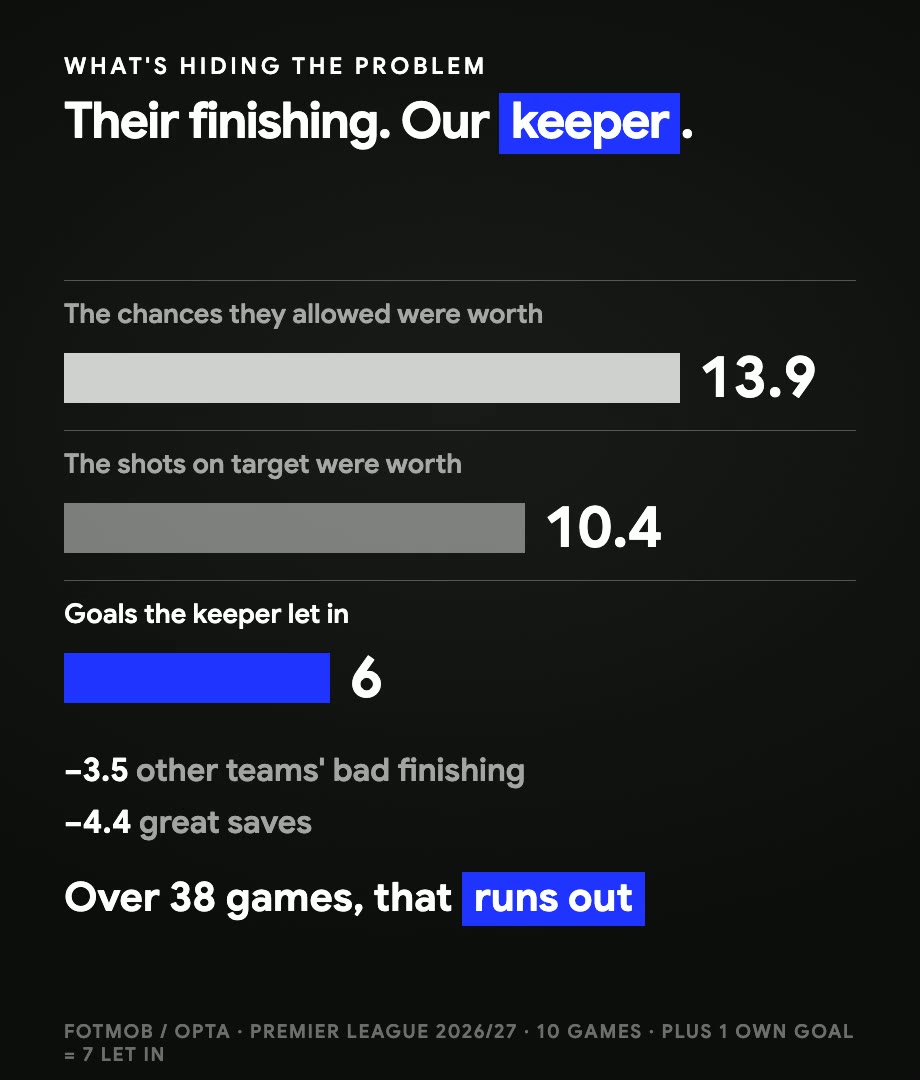
Over a full 38-game season, that kind of luck runs out.
What I would do as Brighton's sporting director
The lesson for any club trying to punch above its weight: never spend your transfer budget trying to fix what is already working. Spend it protecting your biggest weakness.
Everyone is going to tell Brighton to spend big on a striker in January. If I were the sporting director at that club, I would ignore all of it. I would spend that money on a fast, ball-winning defensive midfielder: someone who wins his tackles, covers the open space when the fullbacks push up, and stays back to protect the defence while everyone else attacks.
The corner numbers add a second job, and this one costs almost nothing in transfer fees: a hard look at how they defend set pieces, from the marking set-up to who stands where in the box. I wrote about what a set-piece coach is worth after Arsenal's title.
That is how smart clubs stay at the top. They do not mess with an attack that is already scoring goals, and they use data to fix the defensive holes before the luck runs out.
If you want the bigger picture on Brighton's season, I also asked whether they can win the league after nine games.
The numbers behind this piece
- All match numbers: FotMob (Opta), Brighton's first 10 Premier League games of 2026/27, up to 16 November 2026.
- Goals: 26 (21 open-play and set-piece goals, 2 Groß penalties, 3 own goals by opponents), from 11 different Brighton scorers.
- Expected goals: for Brighton's own shots 19.8, from which they scored 23. Against: 13.6 in FotMob's team stats, 13.9 added up from the shot maps; 7 conceded (6 past the keeper and 1 own goal).
- Groß's fees are as reported, not announced by the clubs.
Which team right now is making the mistake of forcing a big striker into their line-up? Tell me on Instagram or under the video.