Take away Arsenal's corners and they finish third
In July 2021 Arsenal made a signing that never appeared on a team sheet. Nicolas Jover, Manchester City's set-piece coach, moved to the Emirates. Five seasons later, the numbers say he may be the most valuable hire the club has made in that time. This season, they also show how quickly that kind of edge can disappear.
This piece uses Understat's shot data for every Premier League game since 2020-21, which tags each goal by how it was created. "Dead-ball goals" here means goals from corners and free kicks, direct or indirect. Penalties are left out, because a penalty is won in open play.
1. The hire
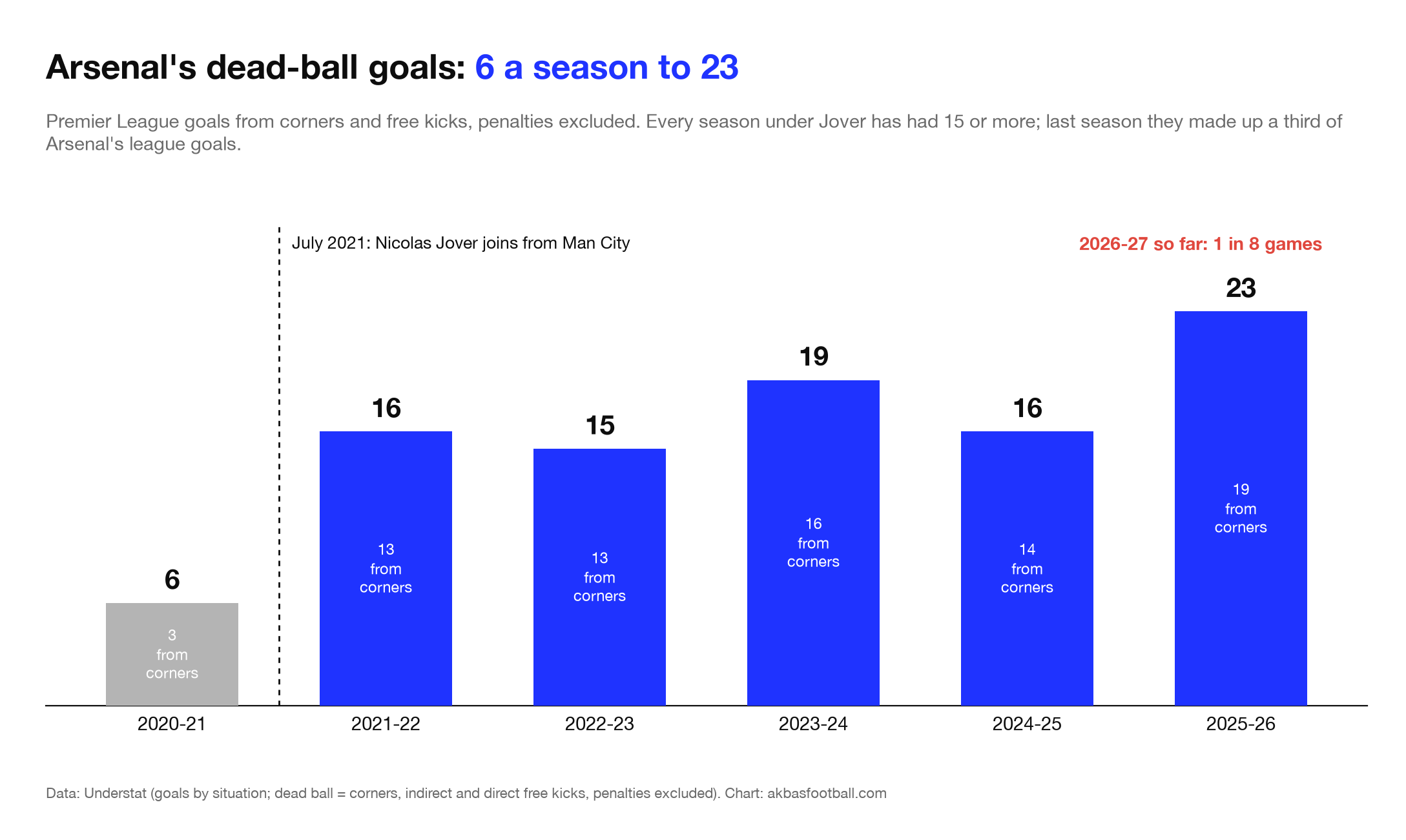
In 2020-21, the season before Jover arrived, Arsenal scored 6 dead-ball goals in the league, 3 of them from corners. In his first season it was 16. It has been 15 or more every season since, and last season it was 23, including 19 from corners, a Premier League record.
Last season those 23 goals were a third of everything Arsenal scored in the league. Of the other 19 clubs, only Tottenham relied on dead balls more (37.5% of their goals), and they finished 17th.
(Opta counts 25 set-piece goals for Arsenal last season rather than 23; the two providers define a set piece slightly differently. The trend is the same either way.)
2. What it was worth
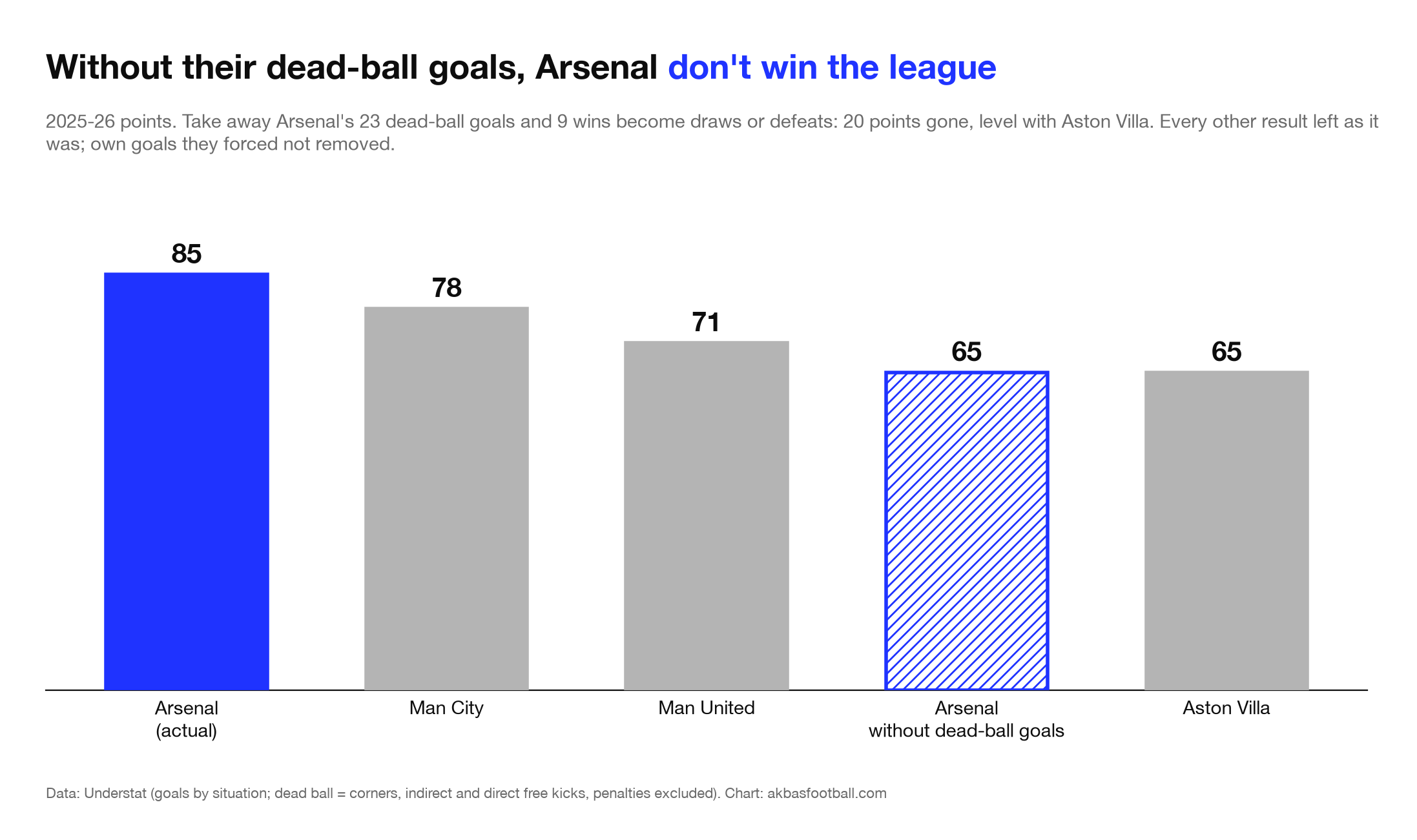
Take every one of Arsenal's dead-ball goals out of last season and replay the results:
- 9 wins change. Five of them were 1-0s settled by a set piece: Manchester United away on the opening day, Fulham, Crystal Palace, Newcastle and Burnley. Two more, Newcastle in September and Chelsea in March, were 2-1 wins in which both goals came from dead balls.
- 20 points go. Arsenal fall from 85 to 65.
- The title goes with them. Manchester City finished on 78. Without the dead balls Arsenal are third, level on points with Aston Villa.
- Corners alone decide it. Take away only the 19 corner goals and Arsenal still drop to 69 points, behind City and Manchester United: third.
That is a simplification. Teams play differently when they are ahead, and every other result is left as it was. Arsenal also forced own goals from corners that I have not taken away, so if anything it understates the effect. But the point stands: last season's title margin came from the training ground, not the transfer market.
3. Then the referees changed what's allowed
Before this season, the referees' body told clubs it would take a firmer line on holding, grappling and blocking at corners and free kicks. No law changed. Referees simply started giving the fouls (France 24 / AFP).
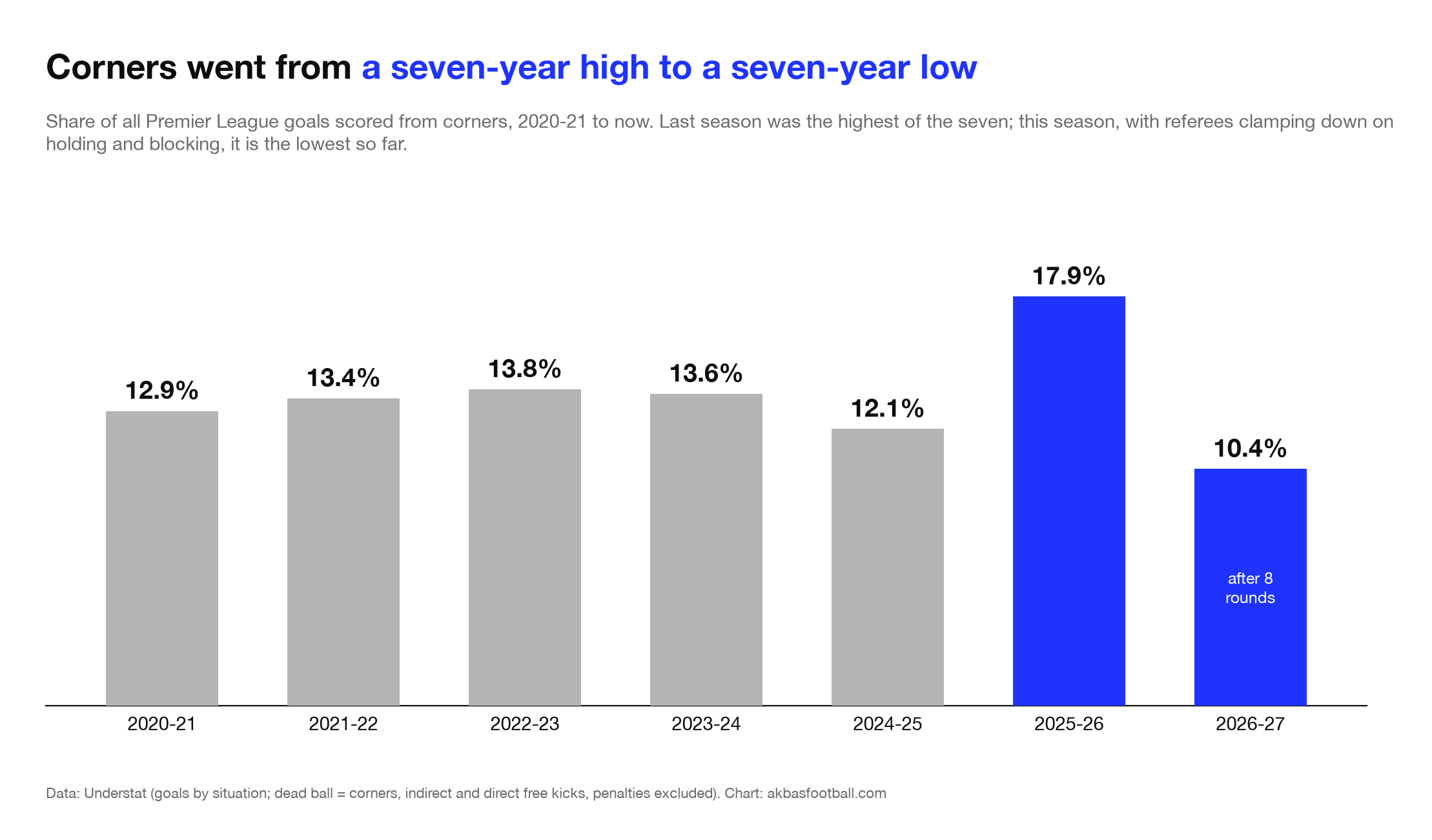
Across the league, the effect is clear. Last season 17.9% of all Premier League goals came from corners, the highest of the last seven seasons. After eight rounds of this season it is 10.4%, the lowest. Opta's count, published by The Analyst, shows the same drop: 18.0% to 9.8%.
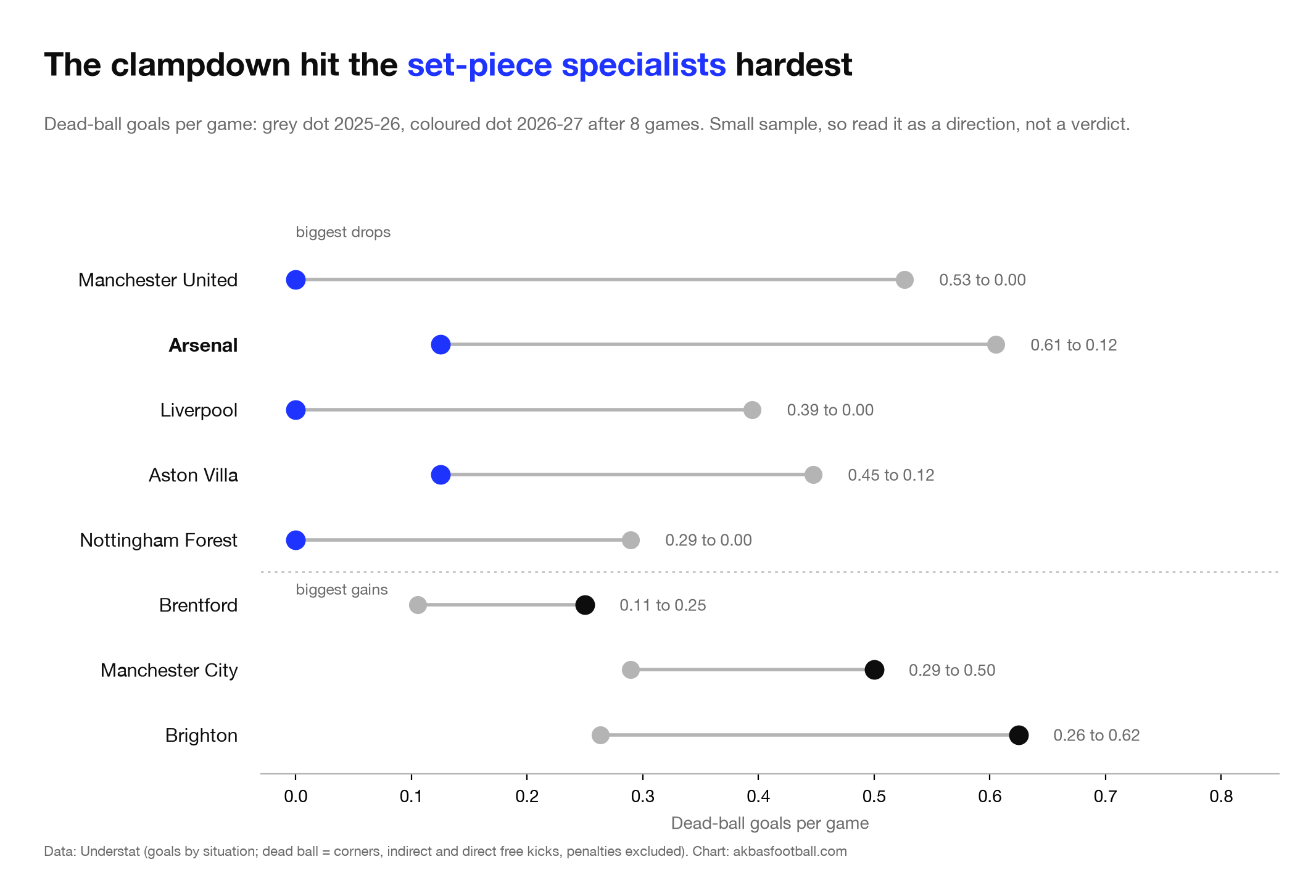
The clubs that relied on dead balls most have lost most. Arsenal have gone from 0.61 dead-ball goals a game to 0.12, a single goal in eight games: Ezri Konsa's tap-in against Everton on Saturday. Manchester United, last season's second-best dead-ball side, have none. Liverpool, Aston Villa and Nottingham Forest have none or one.
At the other end, Brighton, Manchester City and Brentford are scoring more from dead balls than last season. Eight games is a small sample. But it is the pattern you would expect if some coaches built routines that depend on what referees let go, and others did not.
Arsenal have still taken 21 points from their first eight games. Their open play has improved (Sky Sports). A side that wins without its set pieces is a better side than one that needs them.
4. What I would do as a sporting director
Hire one, if you don't have one. Last season Arsenal found 20 points, and a title, from a staff appointment and training time. For a club that cannot outspend its rivals for players, specialist staff are one of the few places you can buy goals without paying transfer fees.
Don't build the team on it. A third of your league goals from dead balls is a dependency, not just a strength. The clampdown shows that part of the edge rests on what referees are willing to allow, and that can change in one summer without a single law changing. The best version of this is a strong open-play team with set pieces on top, which is what Arsenal look like this season.
Judge the coach on how fast he adapts, not on last season's total. The useful measures are the quality of the chances a corner creates and how often your players win the first contact, not goals alone, because eight games of goals tell you very little. The Analyst's figures show Arsenal winning first contact more often this season (42.9%, up from 28.3%) while the chances themselves are worse. That is a coach working on the new rules, and it is where I would look before deciding whether the edge is gone.
Look for the next gap. Every change in how a rule is enforced moves value from the teams that relied on the old version to the teams that adapt first. Brighton and Brentford, two of the best-run clubs in the league, are already scoring more from dead balls. The clubs that study why will be ahead next season.
Would you still pay for a set-piece coach? Tell me on Instagram.
Data: Understat, all Premier League games 2020-21 to 26 October 2026. Points without dead-ball goals: each Arsenal match replayed with their dead-ball goals removed, all other results unchanged. Cover photo: Erik Cleves Kristensen, CC BY 4.0.