Why great attacks keep losing games: watch the fullbacks
Your club has just signed a £100m winger. They create five big chances every half, they have 65% of the ball, and they look like the most exciting attack in the country. Then on Saturday they lose 3-2 to a team that had three shots on target.
Fans blame the centre-backs. Pundits blame the defensive midfielder. I think they are both looking in the wrong place. The deadliest weakness in a modern attack is rarely the finishing. It is what happens in the five seconds after you lose the ball, and where your fullbacks are standing when it happens.
This piece goes through it step by step, with the tactics board from my video. Every animation below plays on a loop, so take your time with each one.
Ten years ago, a fullback's job was simple
Look at the two blue players. They are the fullbacks: the defenders on the outside of the back four, one on each side.
Their job used to have three parts. Mark the winger in front of you. Overlap when you can, which means running round the outside of your own winger to give him a pass. Then get back into a flat back four, level with the two centre-backs.
When the fullbacks get back, four defenders cover the whole width of the pitch. Nobody can run in behind them without someone being close.
Today, fullbacks have two new jobs
Top coaches now ask their fullbacks to do one of two things when the team has the ball.
The first is to bomb down the touchline and stay there, as high as the wingers, to stretch the pitch as wide as it goes. The second is to invert, which means stepping inside into midfield and playing as an extra midfielder. Pep Guardiola made the inverted fullback famous at Bayern Munich and Manchester City, and many top teams have copied it since.
The five-lane attack
Both jobs feed the same idea: the five-lane attack.
Picture the pitch cut into five strips running from goal to goal. Two wide strips by the touchlines, the strip in the middle, and the two strips in between, which coaches call the half-spaces. A five-lane attack puts one player in each strip, right up against the other team's back line.
Four defenders cannot mark five attackers spread across the whole width. So the defence drops deeper and deeper, until it is pinned inside its own penalty box. When this works, your team looks unstoppable.
The catch: the grass behind them
Now look behind the attack.
The higher and narrower your fullbacks push, the more empty grass they leave behind them. While you have the ball, nobody notices. But one simple pass goes astray, and the whole defensive structure rests on a razor-thin margin: two centre-backs and one midfielder.
The five seconds after you lose the ball
When the ball changes hands, two things have to happen straight away.
First, the counter-press: the players nearest the ball swarm it to win it back within about three seconds, before the other team can look up and play forward.
Second, if the press is beaten, the rest defence has to slow the counter-attack down. Rest defence is simply the players who stay in position to defend while the rest of the team attacks.
Two centre-backs, 60 metres of grass
Here is the problem with both fullbacks high. If they are caught 40 yards up the pitch when the ball is lost, the two centre-backs have to cover about 60 metres of width on their own. A pitch is only about 68 metres wide.
Where the fast wingers run
Good counter-attacking wingers do not run at your centre-backs. They curve their runs into the channels the fullbacks have left empty.
Now your centre-back is caught in no man's land, and both of his options are bad.
If he steps out to the wing to meet the runner, he leaves the penalty box empty, and the striker runs into it. If he stays in the middle, the winger drives straight into your final third (the last third of the pitch, in front of your goal) with nobody stopping him.
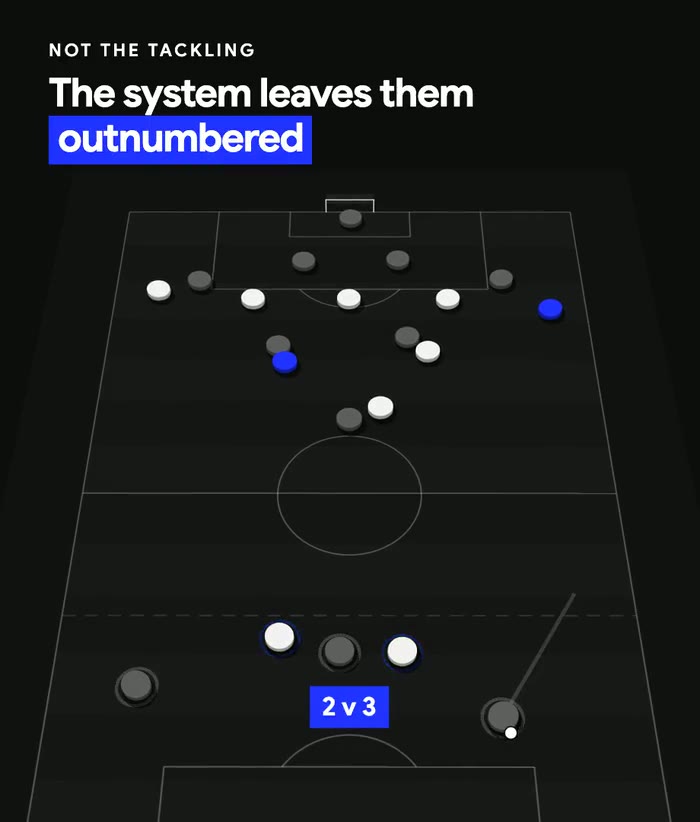
This is why so many teams that dominate the ball look fragile against a low block, a team that defends deep around its own box and waits to break. It is not that their defenders cannot tackle. It is that the system leaves them outnumbered, three against two, before anyone has made a mistake.
How the best teams fix it
The best teams do not let both fullbacks fly forward at the same time.
While one fullback pushes into the attack, the other tucks inside next to the centre-backs. That makes a back three, with the holding midfielder in front of them: three plus one behind the ball instead of two plus one.
The other answer is the type of player you sign. Some teams play both fullbacks high because they have fullbacks with the recovery speed and the stamina to sprint 40 yards back the second the ball is lost.
The two set-ups, side by side
The teams that bleed goals do the opposite of the best teams. They push both fullbacks high, leave one holding midfielder to cover two passing lanes on his own, and expect their centre-backs to win foot races against forwards who are already running.
It does not matter if your attack creates three expected goals a match. Expected goals (xG) is how many goals your chances are worth on average, based on thousands of similar shots. If your transition defence leaks two clear breakaways every weekend, you are playing Russian roulette with points.
What I would look for when signing a fullback
If I am building a squad, this changes what I want from a fullback. Crossing and dribbling still matter, but I would add three questions before signing one:
- When his team loses the ball, does he sprint back or jog back? You can count it on video.
- Can he play both jobs, high and wide one week, tucked inside the next? A fullback who can only do one forces the coach's hand.
- Does the coach want both fullbacks high? Then the recovery speed has to be in the squad already, or the back line needs a third centre-back.
What to watch this weekend
Next time you sit down to watch your team, do not just watch the ball when they attack. Look at the fullbacks the moment an attack breaks down.
Are they sprinting into the recovery channels, or walking back while the centre-backs get exposed? That five-second window will tell you whether your team is a genuine title contender, or just an entertaining attack waiting to be picked apart.
Which team do you think is most guilty of this right now? Tell me on Instagram or under the video.