Arsenal went from bottom to champions in five years. The order they did it in
On 28 August 2021, Arsenal lost 5-0 at Manchester City. Three games into the season they had no points, had not scored a goal, and were bottom of the Premier League. It was their worst start to a league season since 1954-55. Plenty of clubs would have sacked the manager. Arsenal kept Mikel Arteta.
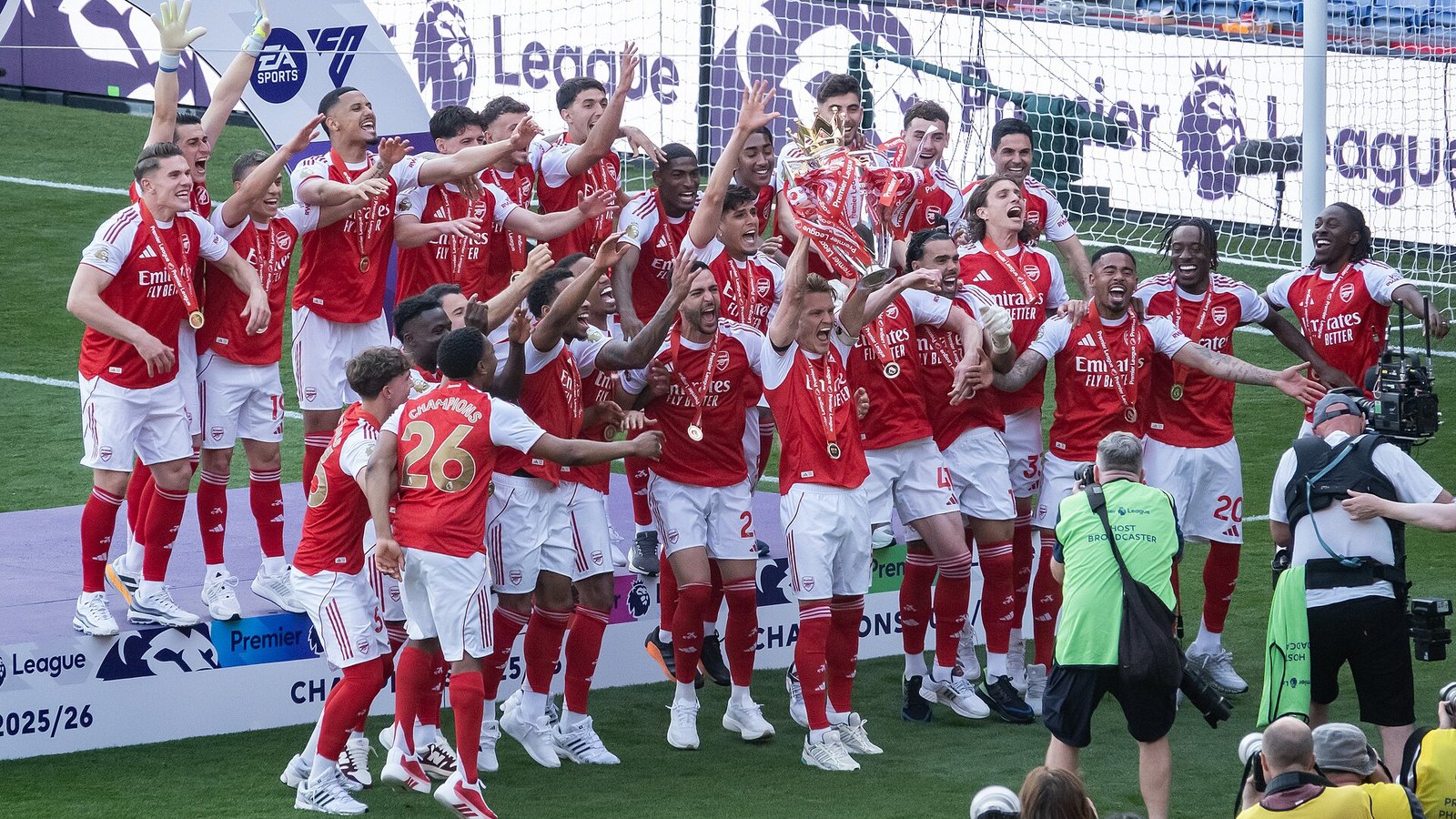
Five years later they are champions of England. This piece goes through how they got there, season by season, using my own counts from every Arsenal league game since that August. The short version: the money mattered less than the order they spent it in.
If you'd rather watch it in 90 seconds, the short video is on YouTube.
1. First, they kept the manager
Three defeats (2-0 at Brentford, 0-2 at home to Chelsea, 5-0 at City) is a results problem. Whether the plan behind them is working is a different question, and it's the one a board should be asking. The press at the time reported that Arsenal's board backed Arteta, and they didn't change course.
That matters for everything that follows. Every decision in this story was made by the same head coach, building towards the same idea of how the team should play.
2. They built a young core and let it grow
That summer Arsenal spent about £149m on six players, and not one of them was older than 23: Ben White (23), Aaron Ramsdale (23), Martin Ødegaard (22), Takehiro Tomiyasu (22), Albert Sambi Lokonga (21) and Nuno Tavares (21). Depending on the source, the total runs from £142m to £157m. After selling Joe Willock to Newcastle, it was about £125m.
To be honest about it, that window was not the whole story. By the title season only two of the six were still playing a real part. Ødegaard played 1,370 league minutes and White 704. The other four didn't play a league minute for Arsenal in 2025-26.
What the window did was set an age profile: a group of players who would reach their best at the same time. Five of the 16 players who passed 1,000 league minutes in the title season were already Arsenal players in August 2021: Bukayo Saka (19 then), William Saliba (20, out on loan at Marseille), Gabriel Martinelli (20), Ødegaard (22) and Gabriel (23).
3. Second, three times, and the season that showed what was missing
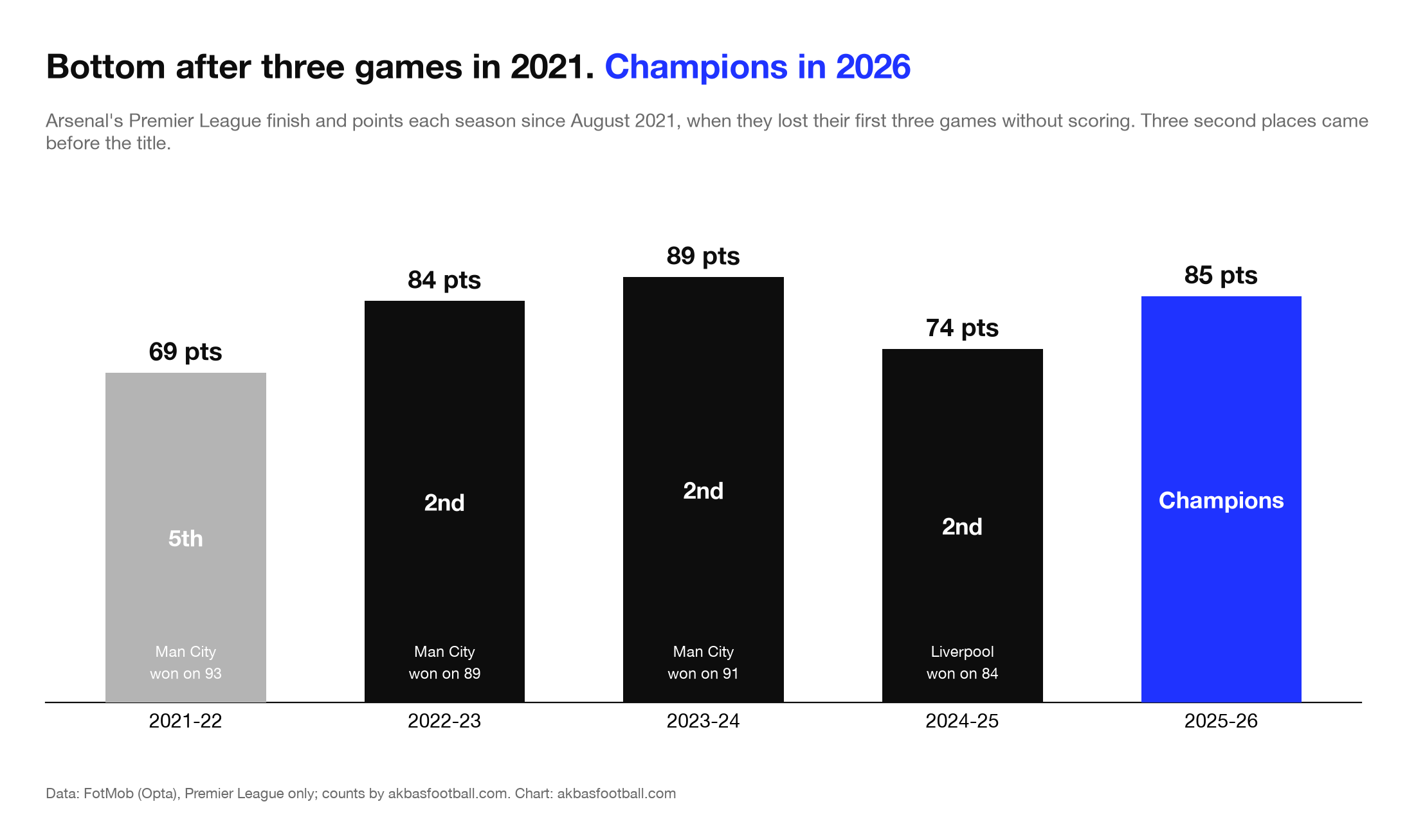
Arsenal finished fifth in 2021-22. Then they finished second three seasons in a row: 84 points to City's 89, then 89 to City's 91, then 74 to Liverpool's 84.
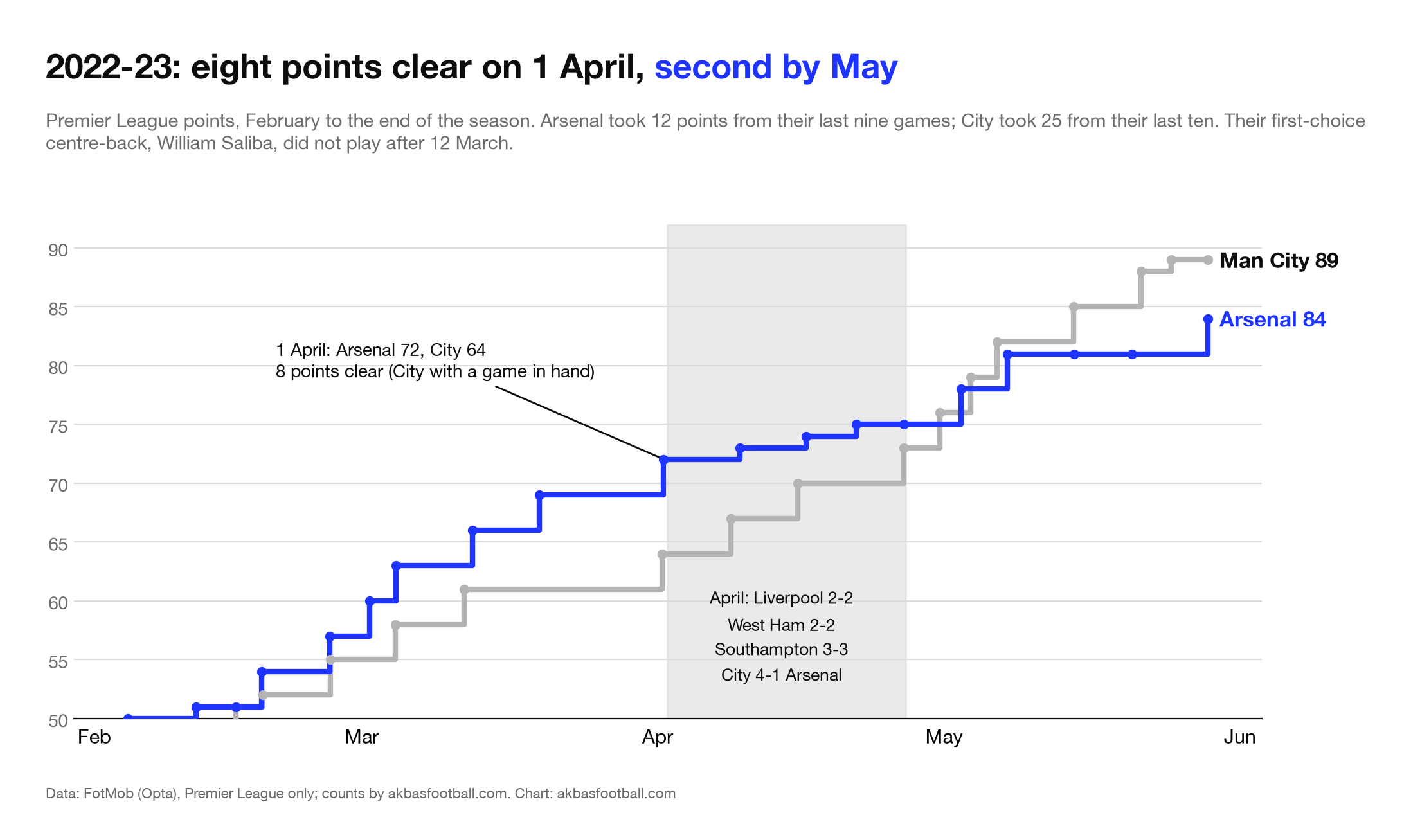
The first of those taught them the most. On 1 April 2023 they beat Leeds 4-1 and went eight points clear of City, who had a game in hand. Then they drew 2-2 at Liverpool, drew 2-2 at West Ham, drew 3-3 at home to Southampton (who finished bottom), and lost 4-1 at City. From 1 April they took 12 points from their last nine games. City took 25 from their last ten.
The minutes show why. In 2022-23 only 12 players passed 1,000 league minutes, which is about 11 full games. The top 11 players played 83% of all of Arsenal's league minutes. That is a team that works brilliantly when everyone is fit, and has very little to call on when someone isn't. Saliba, their first-choice centre-back, didn't play again after 12 March.
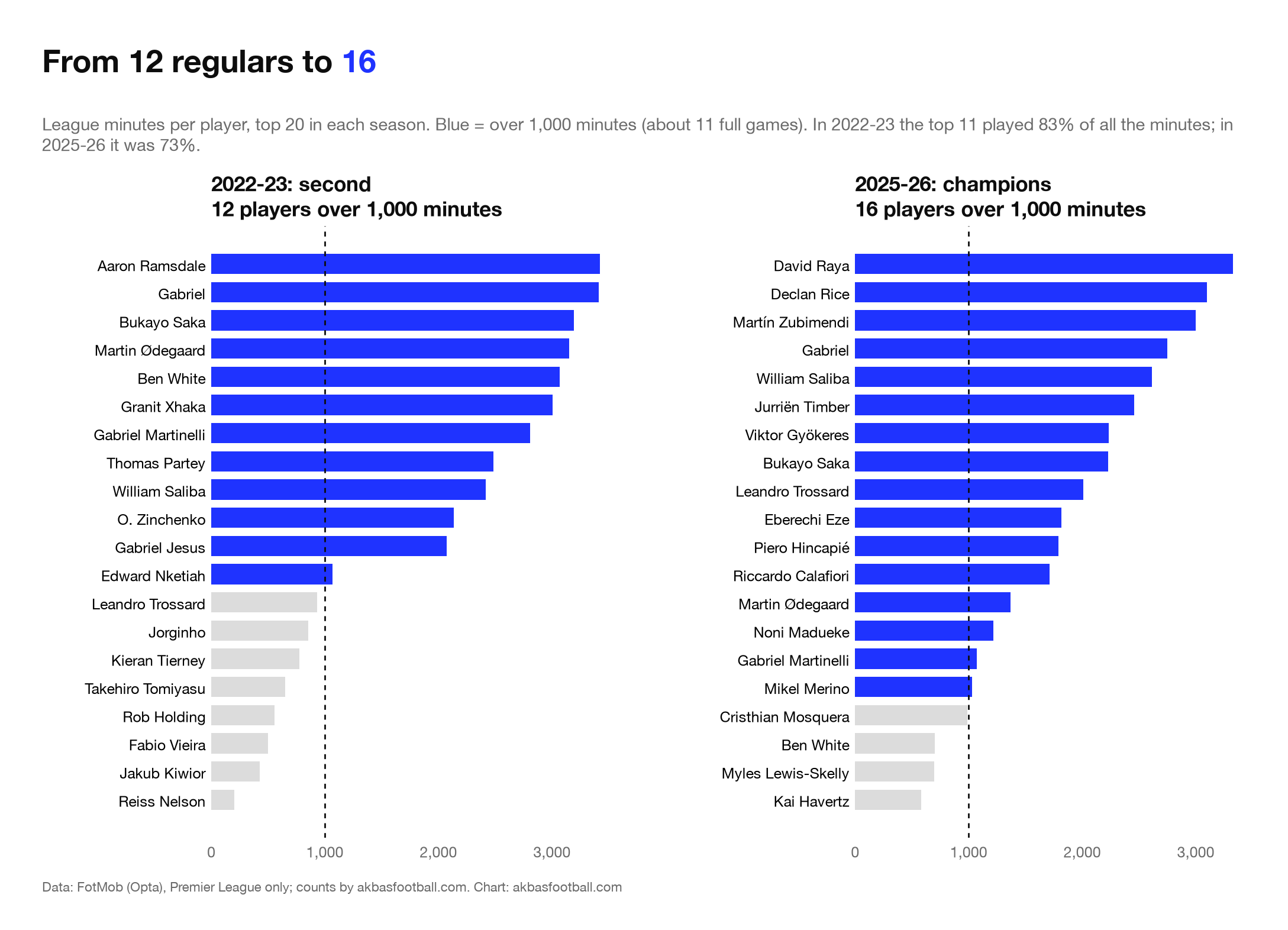
For context, the same count was 16 in 2021-22 (a young squad still being sorted out), 14 in 2023-24 and 15 in 2024-25.
4. Only then did they spend the big money
In November 2024 Edu, the sporting director, left. In March 2025 Arsenal appointed Andrea Berta, who had run Atlético Madrid's transfers for more than a decade. That summer they spent between £248m and £257m, depending on the source.
What they bought matters more than how much. Not one superstar, but the pieces 2023 had shown were missing: a striker (Viktor Gyökeres), a holding midfielder (Martín Zubimendi), and players who could cover more than one position, such as Eberechi Eze, Noni Madueke and Piero Hincapié.
It worked on both counts. Gyökeres scored 14 league goals, twice as many as anyone else in the squad (Saka and Eze scored 7 each). And 16 players passed 1,000 league minutes, with the top 11 playing 73% of the minutes instead of 83%. When someone got injured, the next player was already a regular.
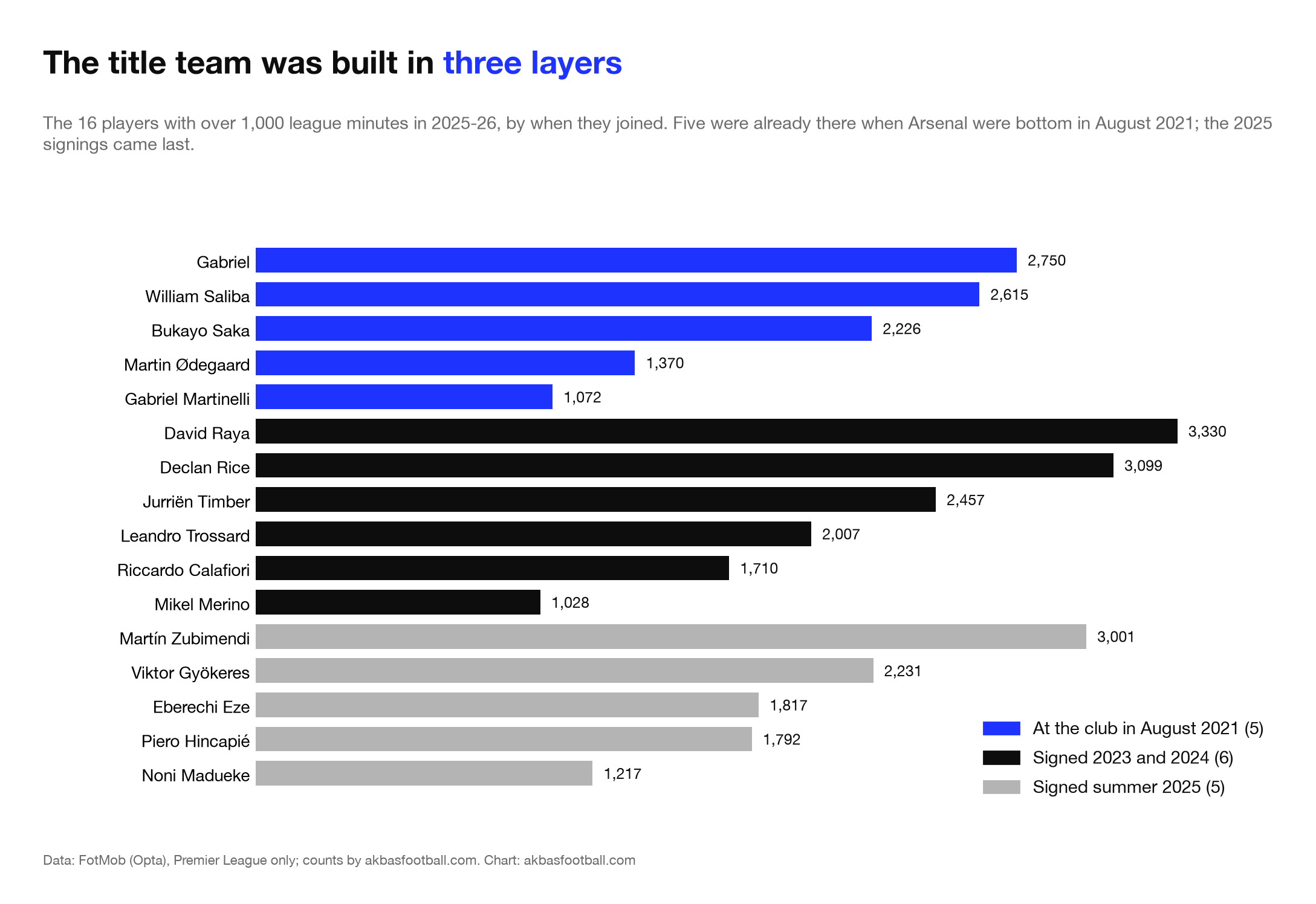
Put the title team together and you can see the order in it. Five players from the 2021 group. Six signed in 2023 and 2024 while they were finishing second. Five from the 2025 spending, last.
5. The biggest difference wasn't on any transfer list
In July 2021, the same summer as the young signings, Arsenal hired Nicolas Jover from Manchester City as their set-piece coach. A set piece is any restart of play: a corner, a free kick or a throw-in.
In 2025-26, 25 of Arsenal's 71 league goals came from set pieces: 19 from corners (a Premier League record), 4 from free kicks and 2 from throw-ins. Arsenal players scored 23 of them, and 2 were own goals by opponents. Penalties are not counted.
Take those 25 goals away, keep every other result as it was, and 12 of Arsenal's 38 results change. They drop from 85 points to 60 and finish fourth, behind City, Manchester United and Aston Villa.
(In my piece in October I had them third. That used Understat's data, which counts only corners and free kicks, 23 goals. The FotMob data used here also counts throw-in routines and the own goals Arsenal forced.)
The fair test: take everyone's set pieces away
When I posted the short video, two of you said the same thing: if you take Arsenal's set pieces away, you have to take everyone's away. Fair point. Every team scores from corners. So I did it for all 20 clubs, across all 380 games of the season.
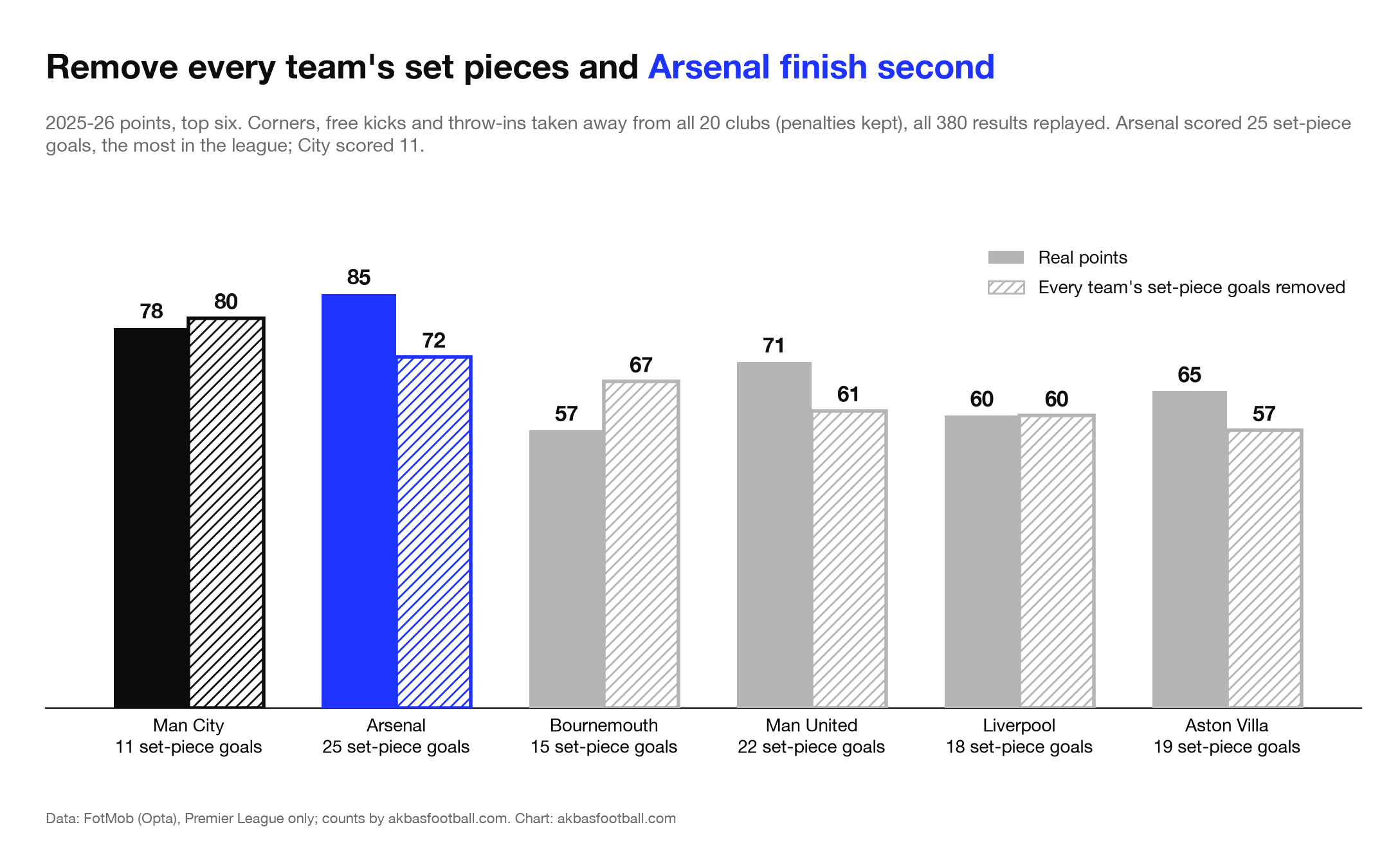
Arsenal still lose the title, but only just. They finish second on 72 points, eight behind City on 80. Arsenal scored 25 set-piece goals, the most in the league. Manchester United scored 22, Aston Villa 19 and City 11. Bournemouth would climb from sixth to third.
So the honest version is this. Set pieces didn't make Arsenal a good team: with nobody's set pieces counted, they still have the second-best record in the league. But the margin that won the title came from the training ground.
One warning sign: after the referees started giving more fouls for holding at corners this season, the edge has shrunk. After ten league games of 2026-27, only 1 of Arsenal's 15 league goals had come from a set piece.
What I would take from Arsenal as a sporting director
- Judge the manager on the plan, not on three results. August 2021 was the moment most clubs change course. Arsenal's title was built by the same head coach who was bottom of the table.
- Build the core young and together. Five of the title team's 16 regulars were at the club, aged 19 to 23, in the summer of 2021. They reached their best at the same time.
- Find out exactly what's missing before you spend the big money. The 2023 run-in showed a squad of 12 regulars. The 2025 money went on that gap: a striker, a holding midfielder and cover. Not on the biggest name available.
- Hire the specialist early. Jover arrived in the first summer of the rebuild, and his goals were worth more points than most signings, for a fraction of what one signing costs. Just don't build the whole team on it: what the referees allow can change in one summer.
Which club do you think is following this order right now? Tell me on Instagram.
Data: FotMob (Opta event data), every Arsenal Premier League game from 2021-22 to 2025-26, and all 380 games of 2025-26 for the every-team set-piece table. Minutes are counted from line-ups and substitution times, without stoppage time. Set-piece goals are corners, free kicks (direct and indirect) and throw-in routines, penalties excluded, with own goals counted for the team that forced them. Spending figures as reported by Sky Sports, Sports Mole, SI and Transfermarkt (via Vavel), checked on 15 November 2026. Cover photo: Chensiyuan, CC BY-SA 4.0, via Wikimedia Commons (cropped).
