Barcelona's big-game problem isn't the attack
Barcelona have scored five or more goals in seven of their 14 games this season: 7-2 against Racing Santander, 6-1 against Alavés, and five each against Elche, Rayo Vallecano, Valencia, Feyenoord and Real Betis. Then, in the space of five days in October, they lost 4-2 at PSG and 2-1 at home to Real Madrid.
That pattern gets a familiar explanation: Barcelona bully small teams and fold when the opponent is good. I wanted to test it properly rather than from memory, so I took every competitive game under Hansi Flick, 131 of them from August 2024 to last Saturday, and split them by how good the opponent was.
The short version: the explanation is half right. Barcelona's attack turns up for big games. Their defence does not.
How I split the games
The split uses Opta's Power Rankings, which rate every club in the world on one scale. Barcelona are fourth. Ten of the clubs in the current top 20 have played Barcelona under Flick: Bayern München, Paris Saint-Germain, Real Madrid, Chelsea, Inter, Atlético Madrid, Benfica, Borussia Dortmund, Club Brugge and Newcastle United. That gives 34 games against the top 20 and 97 against everyone else.
The rankings are today's, applied to games going back to 2024, so a club like Atalanta (third in Serie A in 2025, outside the top 20 now) counts as "everyone else". I checked whether that choice drives the result. It does not (see the last section).
It isn't nerves
Against the top 20, Barcelona have won 20, drawn 4 and lost 10. That is a 59% win rate against the best teams in the world, and it includes six wins in eight games against Real Madrid: 4-0 and 4-3 in the league in 2024-25, 5-2 in the 2025 Supercopa final, 3-2 after extra time in the 2025 Copa del Rey final, 3-2 in the 2026 Supercopa final and 2-0 last May. Barcelona also won LaLiga in both of Flick's full seasons, with 88 and then 94 points.
A team that shrinks in big games does not beat its biggest rival six times in eight. So the problem is something else.
The attack holds, the defence doubles
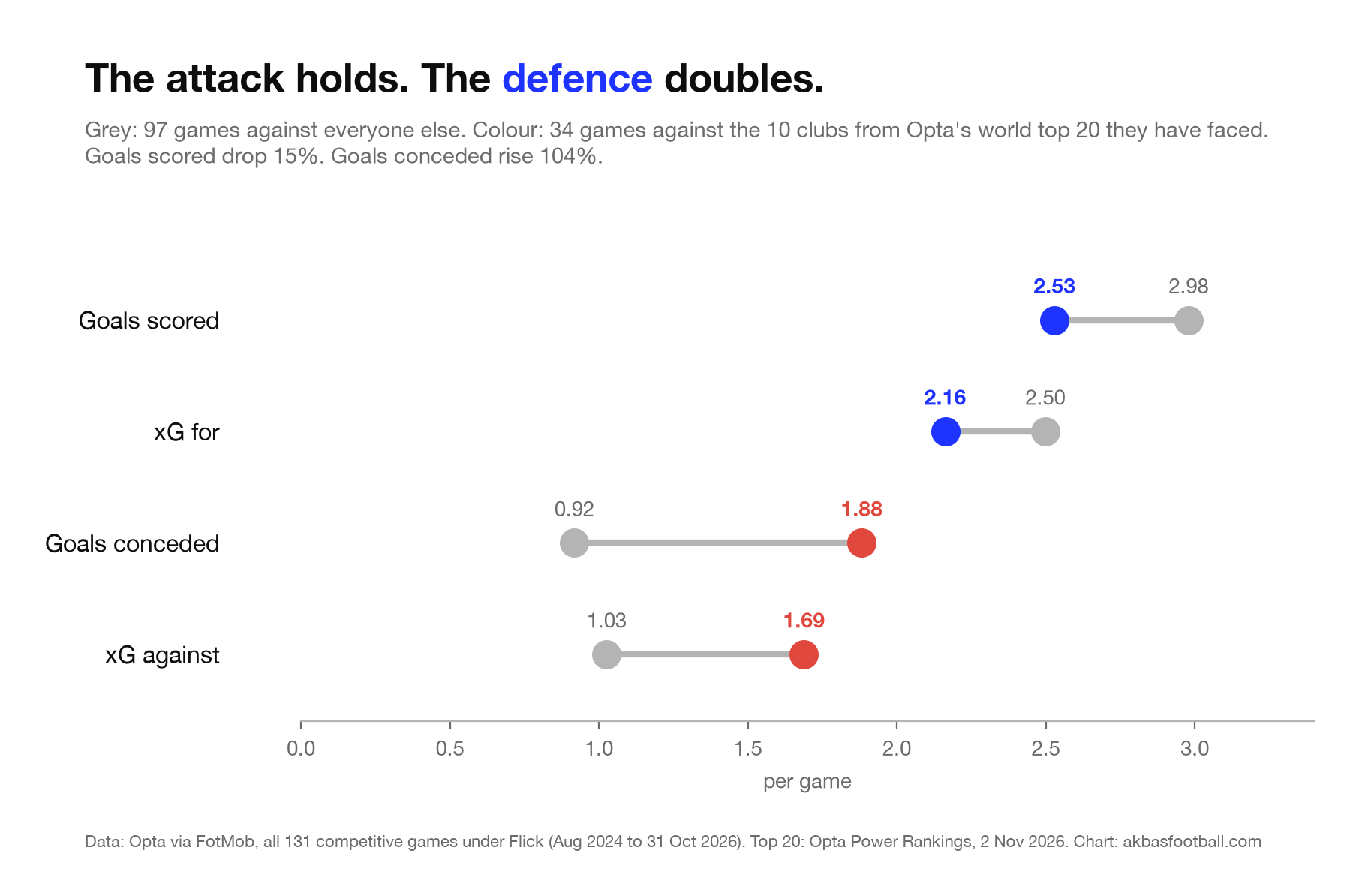
Against everyone else Barcelona score 2.98 goals a game. Against the top 20 they score 2.53, a drop of 15%. Their expected goals (xG: every shot rated by how likely it was to score) fall by a similar amount, from 2.50 to 2.16. Top teams make Barcelona's attack slightly less dangerous. They do not switch it off.
The other end is a different story. Against everyone else Barcelona concede 0.92 goals a game. Against the top 20 they concede 1.88, slightly more than double. Expected goals against rise from 1.03 to 1.69.
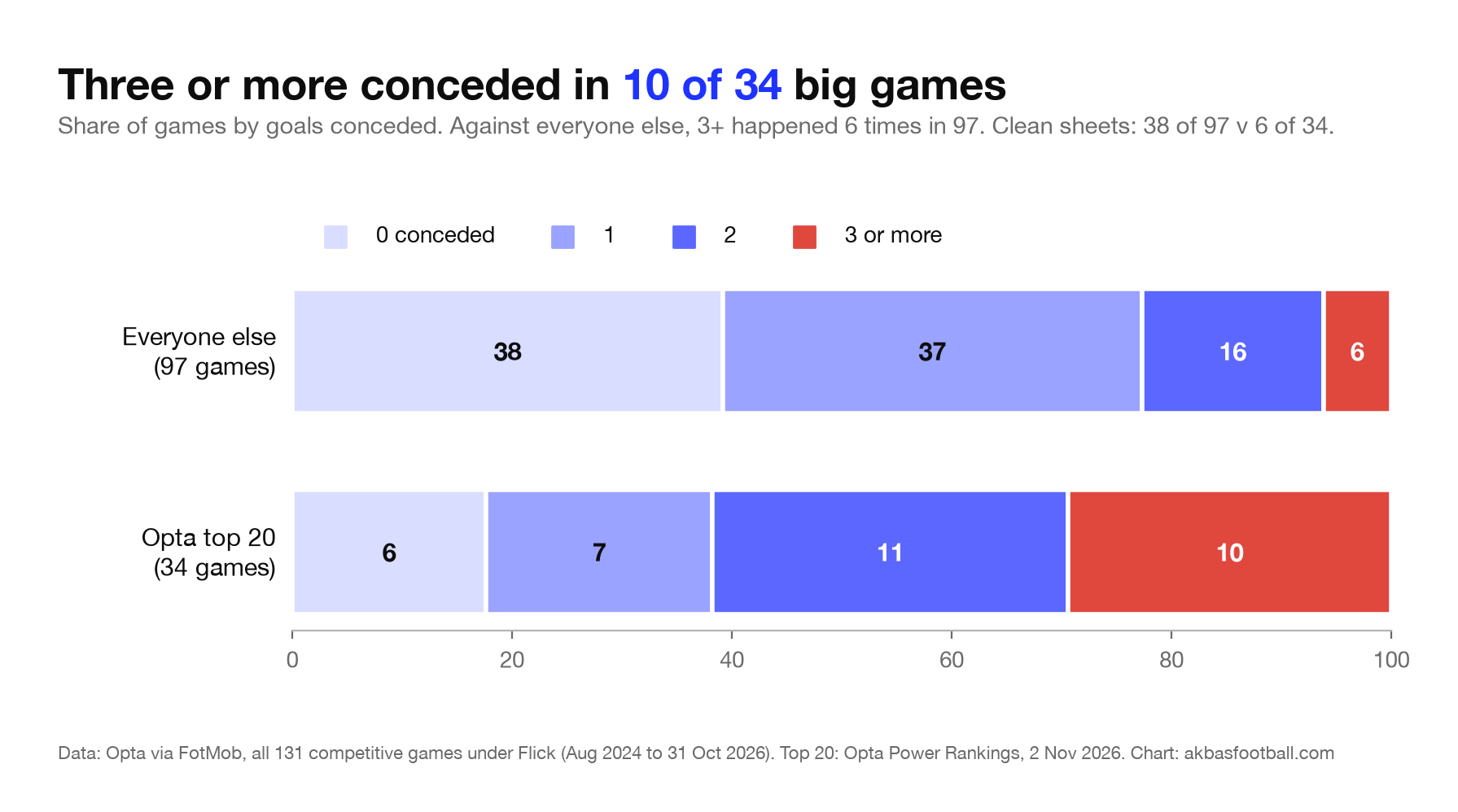
The spread of results makes the point more sharply. Against everyone else Barcelona kept a clean sheet in 38 of 97 games and let in three or more only six times. Against the top 20 they kept six clean sheets in 34 games and let in three or more ten times, almost one game in three.
Where the goals come from
The first explanation most people reach for is the counter-attack: Flick's Barcelona hold a very high defensive line, so good teams must be running in behind it. The data does not support that as the main difference. Opta tags shots from fast breaks, and top-20 opponents had 1.3 of them a game against 1.1 for everyone else. The share of goals conceded from fast breaks is about the same either way, around 15%.
The second explanation is that top teams create better shots. Not really either: 72.5% of top-20 opponents' shots came from inside the box, against 74.5% for the rest, and the typical shot was taken from about the same distance (14.9 metres from the centre of the goal, against 14.4).
What changes is volume.
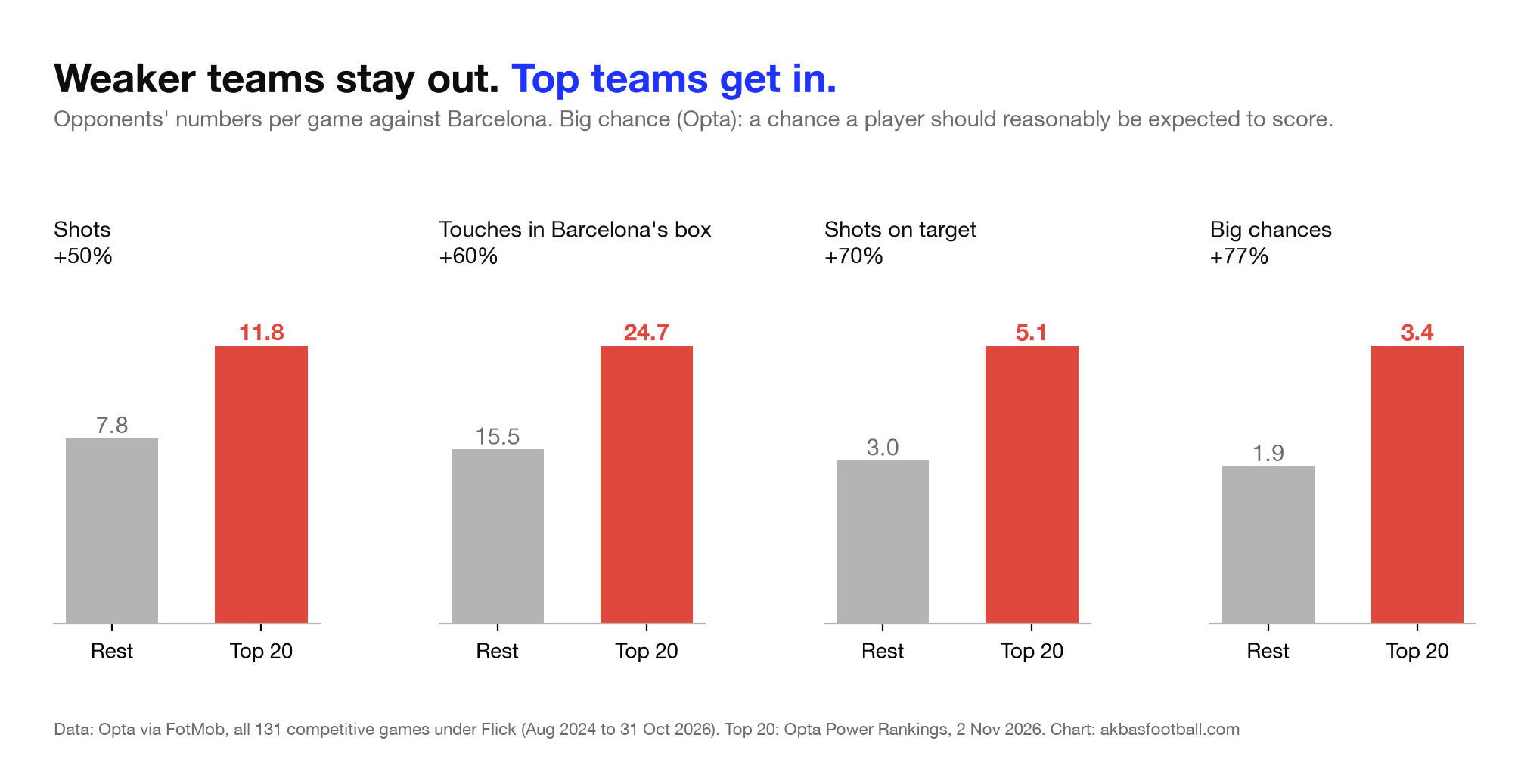
Top-20 opponents take 50% more shots against Barcelona (11.8 a game against 7.8), touch the ball in Barcelona's penalty area 60% more often (24.7 against 15.5), and create 77% more big chances (3.4 against 1.9). Opta defines a big chance as one a player should reasonably be expected to score. Weaker teams mostly cannot get near Barcelona's box. Top teams can, and they do it again and again.
Then they finish. Weaker teams scored 79 non-penalty goals from 742 shots against Barcelona, one in every 9.4, and fewer than their chances were worth (about 92 expected goals). Top-20 teams scored 54 from 375, one in every 6.9, slightly more than their chances were worth (about 51). Part of that gap is quality: elite forwards finish better. Part of it is that their chances arrive in bigger numbers, against a defence that has to keep resetting.
PSG, two weeks ago
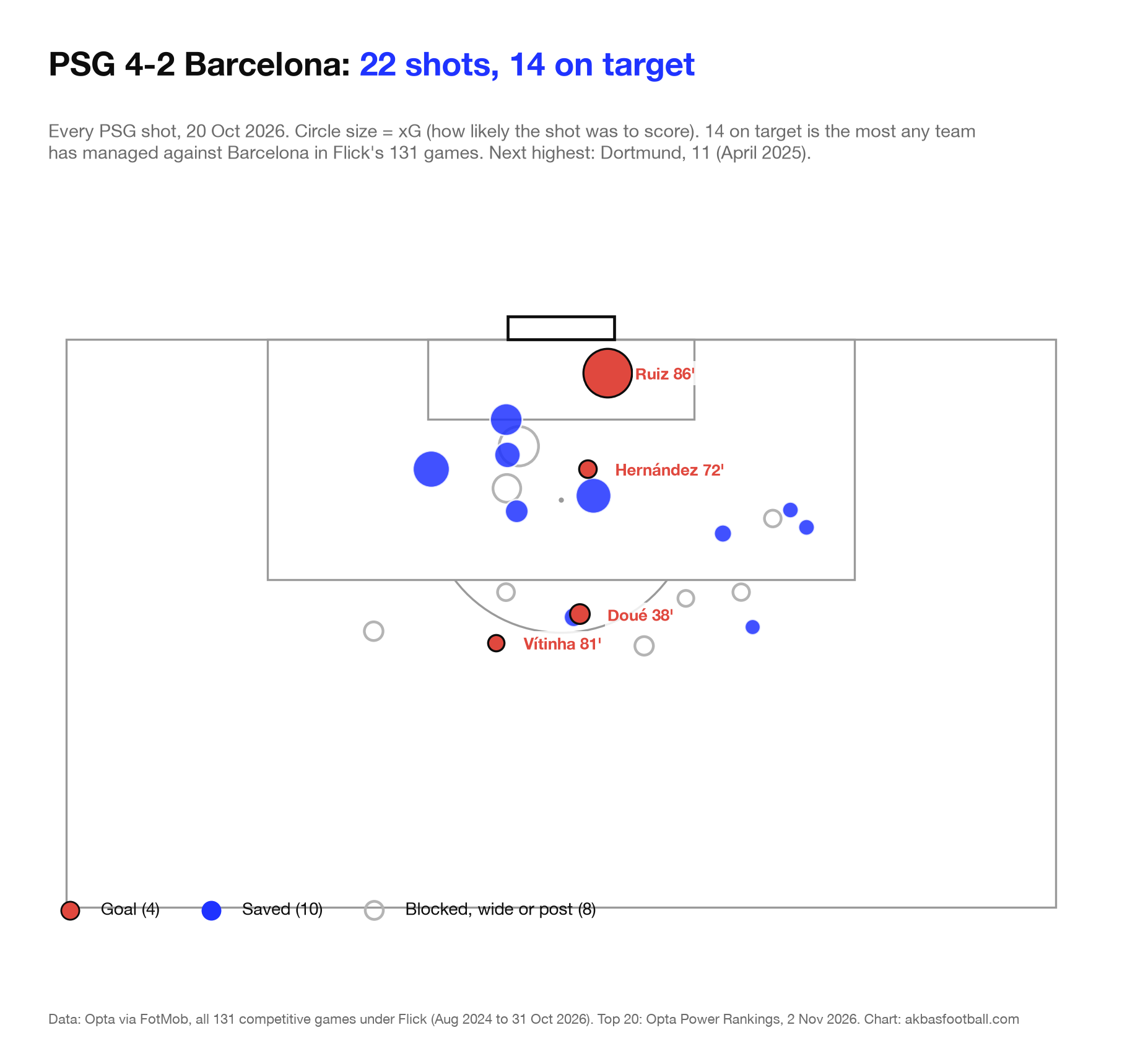
The extreme case was the Champions League game in Paris on 20 October. PSG had 22 shots, 14 of them on target, worth 3.70 expected goals. Fourteen shots on target is the most any team has managed against Barcelona in Flick's 131 games. The next highest is 11, by Borussia Dortmund in April 2025, also in a game Barcelona lost.
Five days later Real Madrid won 2-1 at Spotify Camp Nou with 10 shots and 24 touches in Barcelona's box. Six days after that, Alavés lost 6-1 there with seven shots and 12 touches in the box. That is the whole pattern in one fortnight.
It has cost them in Europe
In LaLiga the leak rarely matters, because Barcelona play the top 20 only a few times a season and score enough to cover it. In knockout football it decides ties. In the 2025 Champions League semi-final Barcelona scored six goals against Inter over two legs and still went out, because they conceded seven. In 2026 they went out in the quarter-final to Atlético Madrid, 3-2 on aggregate. Atlético also knocked them out of the Copa del Rey semi-final that season, winning the first leg 4-0.
Every season, not just this autumn
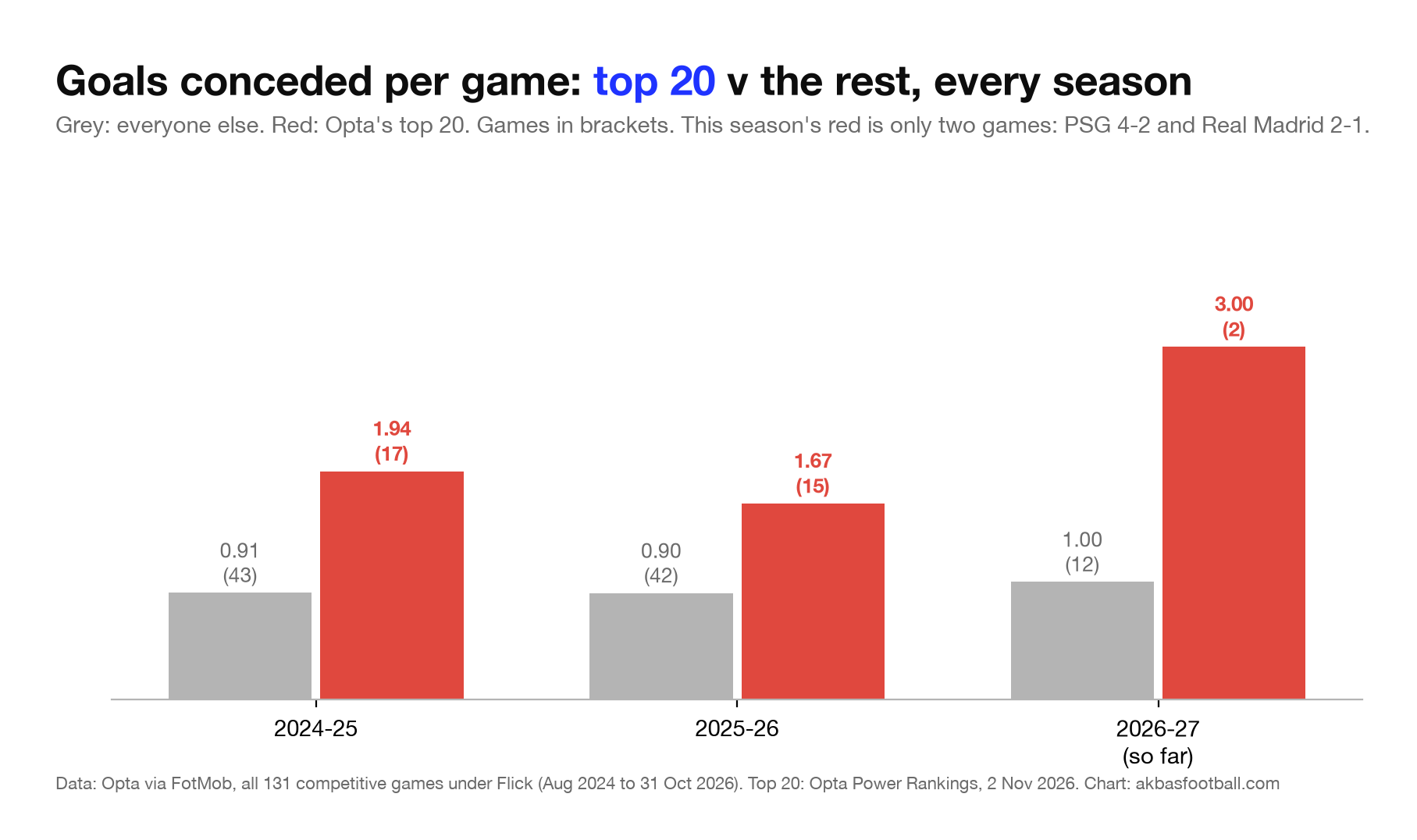
This season's sample against the top 20 is only two games, so on its own it proves little. But the gap is there in both of Flick's full seasons too: 1.94 goals conceded a game against the top 20 in 2024-25, against 0.91 for the rest, and 1.67 against 0.90 in 2025-26.
What the summer says
Barcelona signed eight players this summer. Four were attackers: Anthony Gordon from Newcastle, Karim Adeyemi from Dortmund, Gabriel Jesus from Arsenal and the 18-year-old Jesse Bisiwu from Club Brugge. They also signed Rodri from Manchester City and Mirza Ćatović on loan from Stuttgart, both defensive midfielders, plus João Cancelo and the goalkeeper Dominik Livaković. None was a centre-back, and Ronald Araujo left on loan to Liverpool.
Rodri is a sensible answer to part of this: a midfielder whose job is to stop opponents reaching the box. But the data says the attack is the part of the team that already travels to big games. Four more attackers is spending on the strength.
My verdict
If I were running Barcelona's football side, I would stop judging this team on the 7-2s. They prove the system works against teams that cannot get near the box, which is most of LaLiga. The real test is the 34 games against the world's best, and in those the team concedes almost two a game.
That is not a mentality problem. It is a defensive one, and part of it is the system: a high line wins the ball early against teams that cannot play through it, and leaves space when a team can. A sporting director does not pick the defensive line, but they do pick the defenders. Next summer's money should go on the back line, starting with a centre-back who can defend big spaces against elite forwards, so the system that wins LaLiga does not have to change to survive the Champions League.
This week is a fair test. Aston Villa (10th in Opta's rankings) come to Barcelona on Tuesday in the Champions League, and on Sunday Barcelona go to Atlético Madrid (13th, and second in LaLiga). Watch the other end.
How I measured it
All match data is Opta's, taken from FotMob's match pages for every competitive Barcelona game from 17 August 2024 to 31 October 2026: 87 in LaLiga, 29 in the Champions League, 11 in the Copa del Rey and 4 in the Supercopa. Expected goals is missing for the two January 2025 Supercopa games, so xG figures use 129 games; shot-level figures (conversion, shot location, fast breaks) come from Opta's shot maps, which are also missing for those two games. Conversion rates exclude penalties and own goals. "Top 20" means the top 20 of Opta's Power Rankings on 2 November 2026.
I checked whether the split decides the result. Leaving out the two most marginal top-20 clubs (Club Brugge and Newcastle) gives 1.90 goals conceded a game against the top 20 and 0.95 against the rest. Using only trophy games (Real Madrid, Atlético and Champions League knockouts) gives 1.69 against 1.04. The gap holds every way.
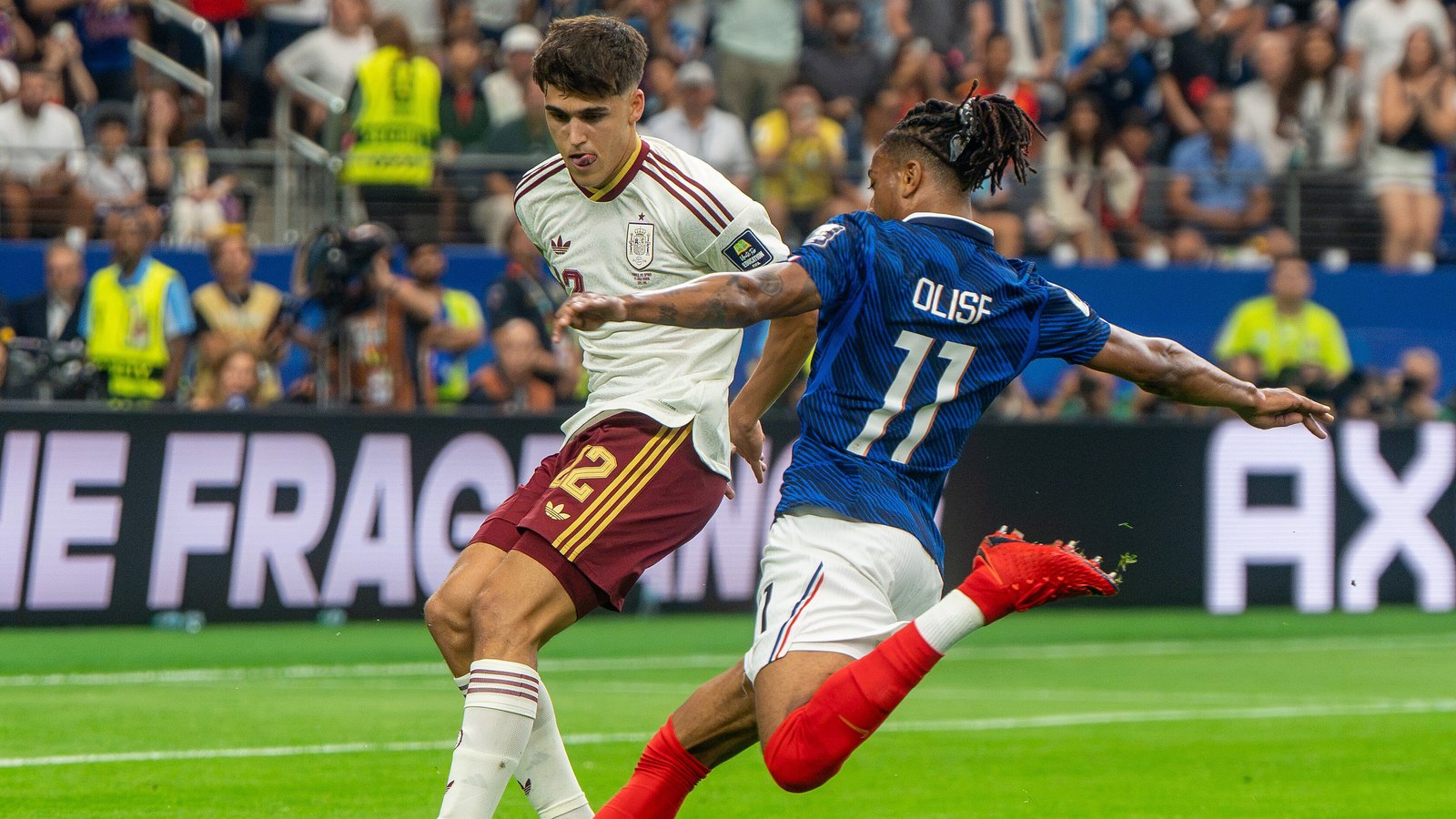
Cover photo: Pau Cubarsí and Michael Olise, July 2026, by Berlination (Wikimedia Commons, CC BY-SA 4.0).