Al-Qadsia 2026-27: a squad audit
Al-Qadsia have won the Kuwaiti league 17 times. The last one was 2015-16. Since then Al-Kuwait have won five in a row, the most recent by 14 points, unbeaten over 23 games. Qadsia finished third last season, level on points with Al-Arabi and one place below them on the tiebreak.
This summer the club answered with the busiest window in the league: nine arrivals, nine departures, and a completely new set of foreign players. The season starts on 25 August. This is what the squad looks like on paper, where I think the risk sits, and what I would be planning for January if I were running the football side.
Everything here comes from public data (Transfermarkt squad and transfer pages, pulled 22 August 2026; Wikipedia for last season's table). Every number in this piece is reproducible from that source. Where the data is thin, I say so.
1. Where they start from
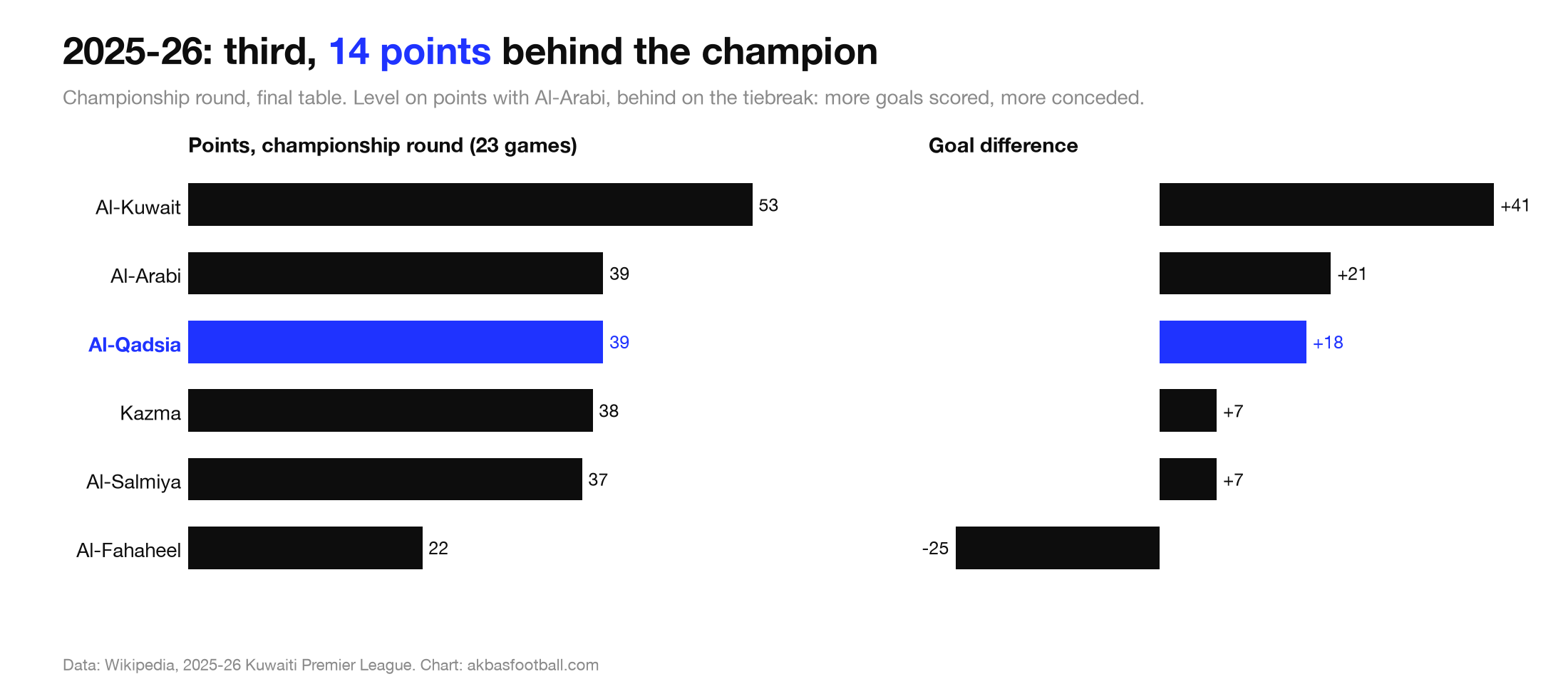
Third place, 39 points from 23 championship-round games, 38 scored and 20 conceded. Al-Kuwait: 53 points, 56 scored, 15 conceded. That gap is at both ends of the pitch, but the bigger half is the 18 goals fewer scored. Qadsia's regular-season defence (14 conceded in 18) was the second best in the league; the attack (32 in 18) was also second best, but a long way behind the champion's 46.
The honest reading: last season's team was good enough to be the best of the rest and nowhere near good enough to win. A club with Qadsia's history does not accept "best of the rest" as the plan.
2. What the window did
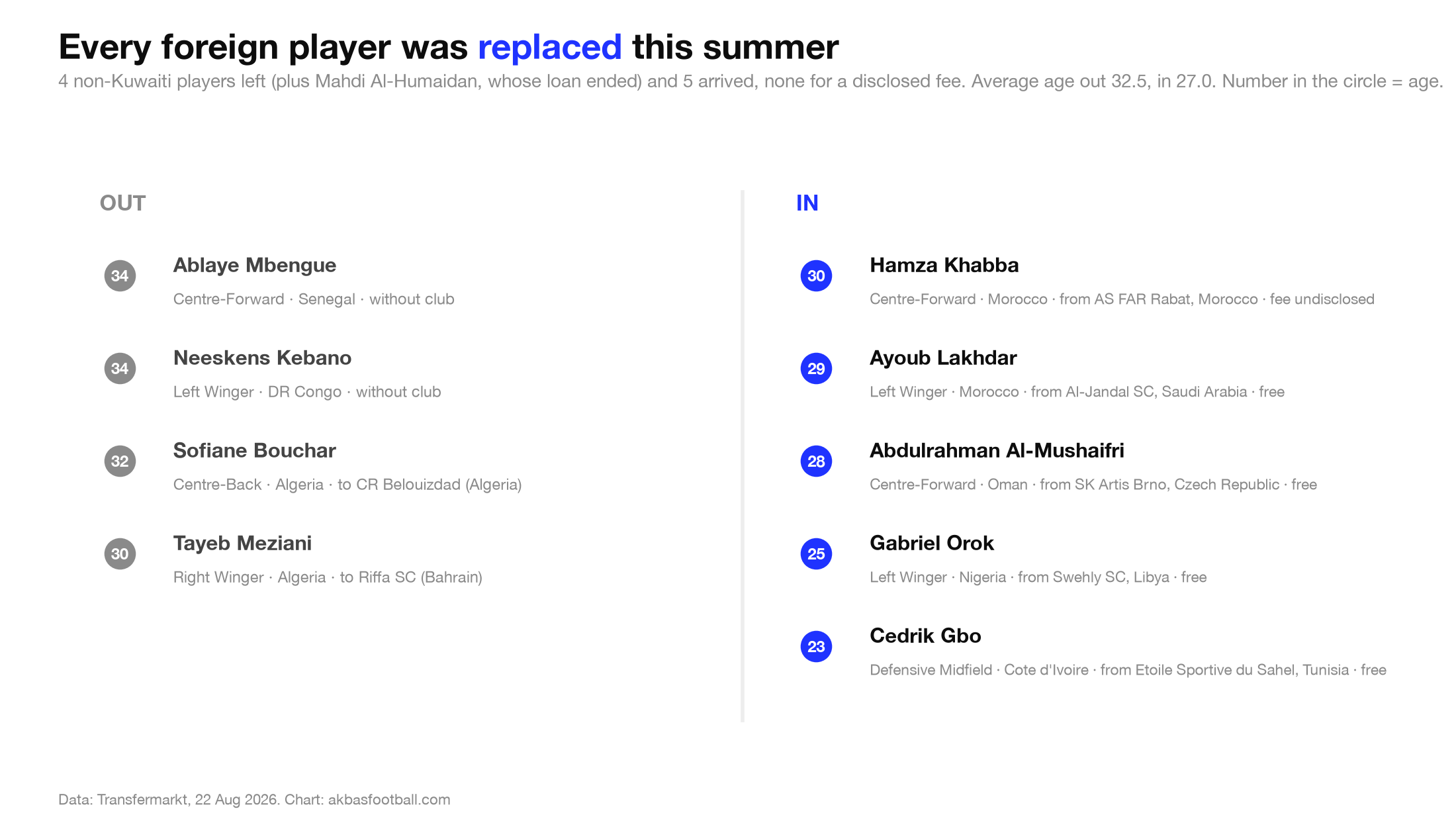
All five of last season's foreign players are gone: Neeskens Kebano (34, released), Ablaye Mbengue (34, released), Sofiane Bouchar (32, to CR Belouizdad), Tayeb Meziani (30, to Riffa), and Mahdi Al-Humaidan (33, loan ended). Five new ones came in: Hamza Khabba (30, centre-forward, AS FAR), Ayoub Lakhdar (29, left winger, Saudi second tier), Abdulrahman Al-Mushaifri (28, centre-forward, Czech top flight), Gabriel Orok (25, left winger, Libya) and Cedrik Gbo (23, defensive midfielder, Étoile du Sahel). Average age of the foreign group dropped from 32.5 to 26.6. Nobody cost a disclosed fee.
Four Kuwaiti players arrived too: goalkeepers Saud Al-Jenaie (32, from Al-Shabab) and Mohammed Al-Kandari (21, from Al-Kuwait), right-back Bader Jamal (30, from Al-Salmiya), and the 20-year-old forward Meqdad Ali Safar from Al-Arabi.
Read the pattern, not the names: four of the five foreign places went to attackers, one to a holding midfielder, none to a defender. The club decided the problem was goals. That is defensible given the numbers above. It is also a bet with no hedge, and I come back to it below.
3. The squad, line by line
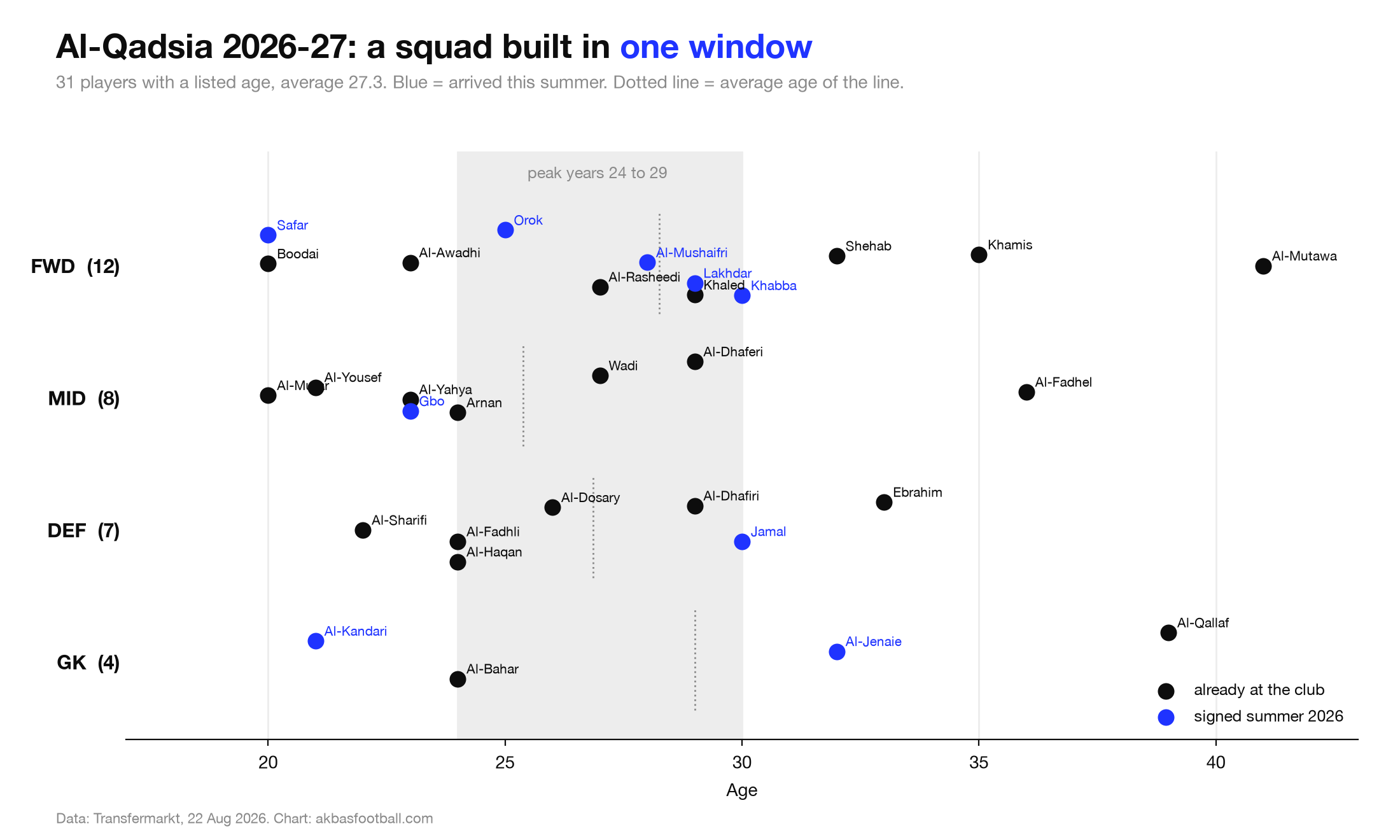
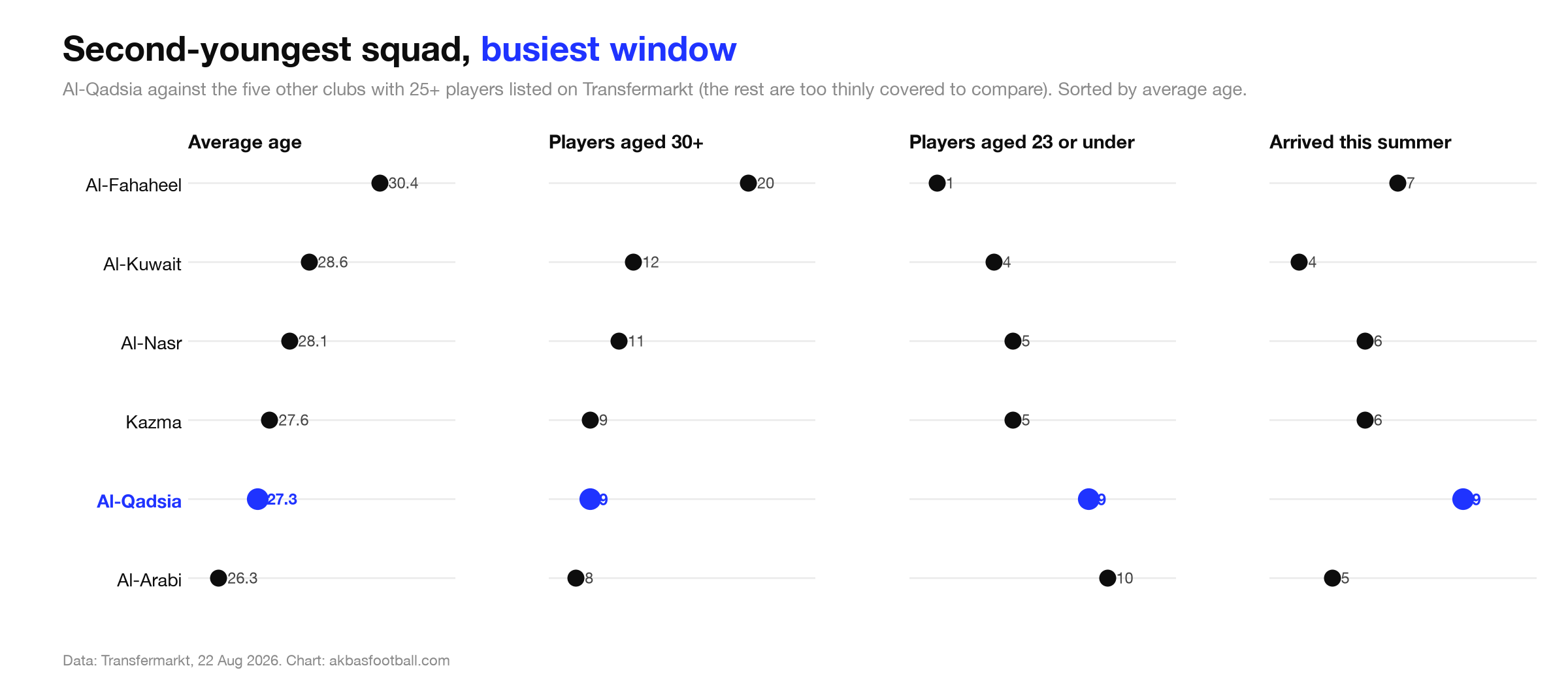
32 players are listed, 31 with an age. Average 27.3, median 27. Nine are 30 or older, nine are 23 or younger. Compared with the other well-covered squads in the league, that makes Qadsia the second-youngest (Al-Arabi, 26.3, are younger) and the club with the most summer arrivals.
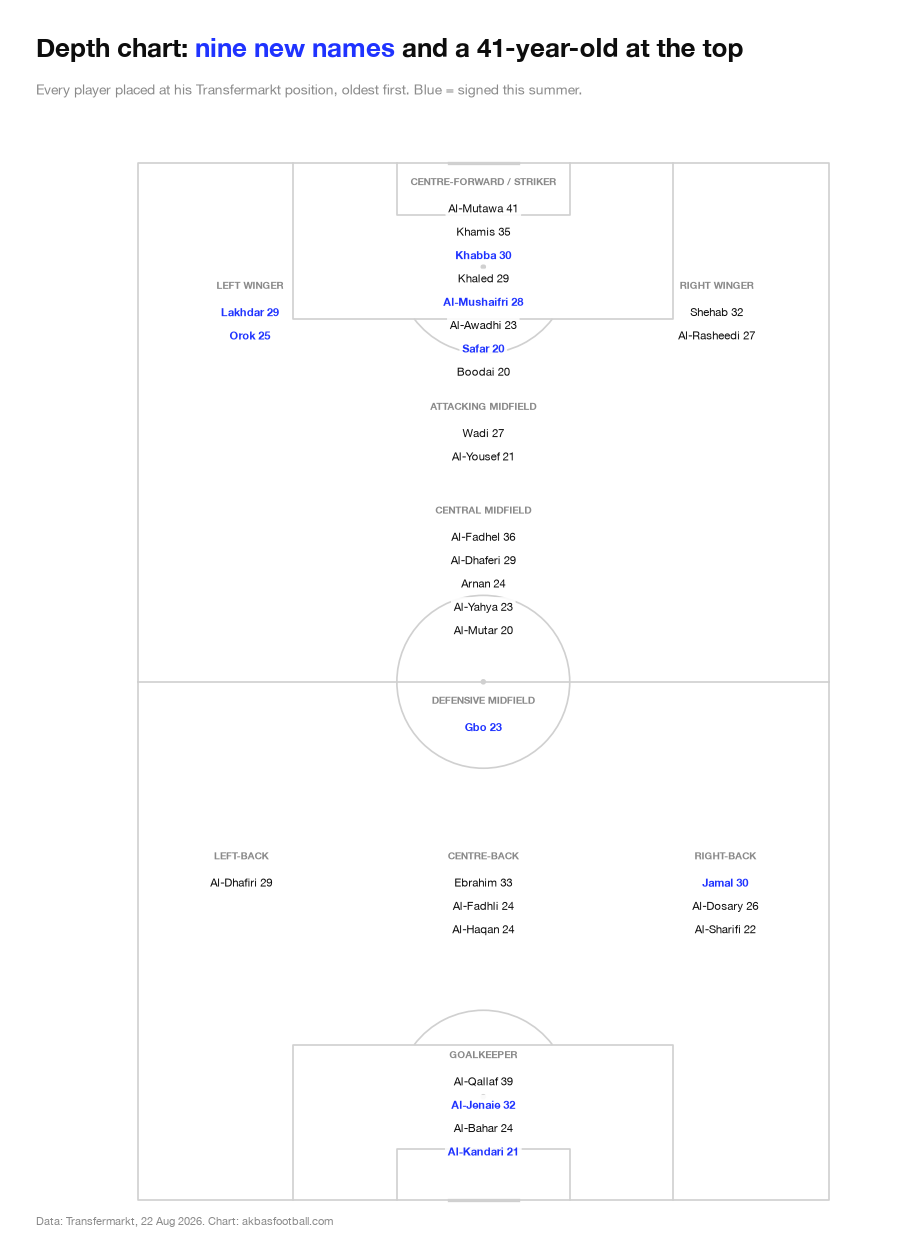
Goalkeepers (4). Hameed Al-Qallaf is 39. Al-Jenaie (32) looks like the intended starter, Al-Bahar (24) and Al-Kandari (21) the succession. This line is fine, arguably over-stocked, and the only one where the club visibly planned for the next three years.
Defence (7, average age 26.9). Three centre-backs: Khaled Ebrahim (33), Khaled Al-Fadhli (24), Yousef Al-Haqan (24). Three right-backs: Jamal (30), Al-Dosary (26), Al-Sharifi (22). One left-back: Moaath Al-Dhafiri (29). Bouchar, a starting centre-back, left; the only defensive arrival plays a position that already had two players. So the back line lost a starter, gained cover where it did not need it, and has a single specialist left-back with no listed understudy. This is the thinnest line in the squad.
Midfield (8, average age 25.4). The youngest line and the one with the clearest shape problem. One recognised holding midfielder, Gbo (23), newly arrived from Tunisia. Behind him in that role: Talal Al-Fadhel, who is 36. Five central midfielders, three of them 24 or under (Arnan 24, Al-Yahya 23, Al-Mutar 20), plus Wadi (27) and Al-Yousef (21) as the attacking options. Lots of bodies, little experience at the base.
Attack (12, average age 28.2). Eight centre-forwards or strikers. Eight. Bader Al-Mutawa is 41 and still listed; Abdulhadi Khamis is 35. Then Khabba (30), Meshal Khaled (29), Al-Mushaifri (28), Al-Awadhi (23), Safar (20), Boodai (20). Two left wingers, both new (Lakhdar, Orok). Two right wingers (Shehab 32, Al-Rasheedi 27). Nobody will play eight strikers; two or three will get the minutes, and the rest are either development cases (Safar, Boodai) or respect contracts (Al-Mutawa). But it tells you where the club's attention went.
4. What I would worry about
The bet is all on one end. Four foreign attackers and a 36-year-old as the second holding midfielder. If the new front line scores, this squad finishes second. If it takes until November to gel, the games Qadsia lose will be the tight ones against Al-Kuwait and Al-Arabi, and those are decided by the lines that were not reinforced: centre-back and the pivot.
The left side of the defence has no spare. One left-back, 29, and no natural cover listed. One injury and a right-back or a centre-back plays there for two months. In a squad of 32 that is a planning miss, not bad luck.
Foreign places are spent. Five non-Kuwaiti nationals are on the books and all five arrived this summer. If the rules allow five (that has been the registration limit in recent seasons; I could not verify 2026-27), a January foreign signing means releasing one of the summer group. Which makes the two oldest bets, Khabba (30) and Lakhdar (29), the ones under the microscope by December. That is the uncomfortable logic of spending every slot in one window.
The data gap a real sporting director would fix first. Transfermarkt lists contract end dates for only 6 of the 32 players and market values for 11. I cannot audit the contract cliff from outside. Inside the club that is a two-hour job and the first thing I would put on the wall: who is out of contract in June 2027, and who among the nine over-30s is being extended.
5. January, if it goes wrong
If Qadsia are third again at the winter break, the line to blame is not the attack. It is the one that was ignored in August. My January list, in order:
- A centre-back who can play left side (left-footed or comfortable there). It covers the two thinnest spots at once and costs a foreign slot only if the Kuwaiti market has nobody, which is the first question to ask.
- A second holding midfielder under 28, so Gbo is not one knock away from a 36-year-old.
- Not another striker. Eight is enough.
And the one structural decision that outlasts January: a written plan for the 20- and 21-year-olds (Safar, Boodai, Al-Mutar, Al-Yousef, Al-Kandari). Nine under-23s is an asset only if someone decides who gets minutes and who goes on loan. Otherwise it is a number on a spreadsheet.
What this audit does not know
No public minutes data exists for the Kuwaiti league, so I cannot say who actually played last season, which is the single biggest blind spot here. Transfermarkt's Kuwait coverage is uneven (some clubs list only six players, which is why the comparison chart uses six clubs, not twelve). Ages are as listed on the squad page on 22 August. Foreign-player limits are quoted from recent seasons, not confirmed for this one. If any of this is wrong, the charts are rebuilt in one command and the text changes with them.
Method and code: the charts are generated from Transfermarkt's public pages with a small Python pipeline (cached, one request per page). Data: Transfermarkt, Wikipedia. Charts: akbasfootball.com.